Something I’ve been chewing on with the recent annual spate of “this year in reading” social media proclamations is my discomfort with the book as a form of media exceptionalism. People brag about how many books they read, how often they read books, and what books they read in a way that simply doesn’t exist with other forms of media People get excited about end of year publishing sales more than magazine subscription sales. A pile of 50 unread magazines is treated with a far different attitude than a pile of 50 unread books. People post “shelfies” of books they have to read, but not screenshots of their podcast queues.
I also have a lot of straight up insecurity around the number of books I read, because it is a number that has nothing to do with how much of my time I actually spend reading. I read a ton of news, pamphlets, zines, magazines, long-form investigative journalism, the occasional literary journal, and academic journals. I gut tons of academic books. None of these items make it on to my annual compiled list of what I read. Putting together a “books I read this year” list is at odds with trying to convey how my media consumption actually shapes my understanding of the world, since magazines and podcasts and even social media accounts influence me as much as books.
As a slow reader, I look at the number of books I read compared to other readers and feel really self-conscious about how few books I read compared to others (even though I often read dense non-fiction books that are well over 500 pages, and I came close to my own personal reading goal this year). But I have to remind myself that the number of books read is not a proxy for time well spent. Time spent with friends and time spent outdoors is just as vital to my intellectual development and personal well-being as reading.
Last year I did a reading roundup of thematic highlights of my favorite books (quality and context over quantity, baby). I’m repeating that format this time, but with other media mixed in besides books.
Water
The Poisoned City: Flint’s Water and the American Urban Tragedy (book, Anna Clark): An excellent foregrounding of the urban history of Flint, Michigan informs this book about the city’s water crisis. Clark does a great job of making clear that the water infrastructure problems in Flint are not unique, but exist across the country.
Rising: Dispatches from the New American Shore (book, Elizabeth Rush): Hands down my favorite environmental book I read this year. Elizabeth Rush visits the communities already suffering from sea-level rise and treats their stories with a significant amount of compassion and empathy. The story about the community on Staten Island working through managed retreat deeply shaped how I think about the topic of adaptation to changing coastlines.
The Water Will Come (book, Jeff Goodell): This was a fascinating book to read right after Elizabeth Rush’s book, because while the book’s premise is very similar, Jeff Goodell is like Hunter S. Thompson trawling for the most outlandish stories to Rush’s gentle but determined Rachel Carson approach. One of the more memorable stories is when he interviews the benefactor of the Perez Art Museum in Miami, Florida.
The Death and Life of the Great Lakes (book, Daniel Egan): This was the first thing I read when I began preparing for my Access keynote since I knew I wanted to focus on the Great Lakes. A great historical overview of the many, many human interventions in the Great Lakes watershed and the cycles of pollution and renewal it has undergone over the last 200 years.
The Lawyer Who Became DuPont’s Worst Nightmare (article, Nathaniel Rich): This is the article that inspired the movie Dark Water (which I also highly recommend!). As with the book by Anna Clark, Rich makes it clear that the water issues particular to DuPont’s devastation of Parkersburg’s water supply is not limited to just the initially affected area, but exemplifies similar stories happening elsewhere.
The Allegheny Front (podcast): This podcast is produced out of Pittsburgh, and it often covers regional environmental stories, including those about the Ohio River. The podcast has covered everything from the ORSANCO debacle to the emerging threat of new petrochemical facilities in the watershed.
Energy
Cultures of Energy (podcast): Although this podcast is now on hiatus, Dominic and Cymene have a massive back catalog of interviews with other (mostly) academics that delve into their research areas. Most of the scholars work in energy studies, but other environmental studies topics like water, plant, and food studies sometimes come up.
Thunder on the Mountain: Death at Massey and the Dirty Secrets Behind Big Coal (book, Peter Galuszka): An easy to read overview of one of the deadliest coal mine explosions in recent years, and a short history of the coal wars in Appalachian between labor and management. Read this to find out why former CEO Don Blankenship ranks among the worst people on Earth.
Tarot (yes really)
Modern Tarot (book, Michelle Tea): This was the first book I read about tarot when I wanted to begin exploring but didn’t really know where to start. The book is arranged into short chapters that correspond with the major and minor arcana of the Rider-Waite-Smith deck and its derivatives. This book is a little more Witchy with a capital ‘W’ than I tend to roll (for example, every chapter ends with a spell, many of which use very specific crystals), but I still found it to be a super accessible intro to tarot since it keeps things pretty simple and also uses a lot of gender inclusive language.
The Creative Tarot (book, Jessa Crispin): This book is great for folks who don’t use tarot for divination (reading the future) but are interested in it for its capacity to generate ideas and support creative work. Crispin includes recommended books, music, and painting to correspond with each card, and a number of spreads (ways to lay out your cards) for finding inspiration, clearing roadblocks, etc.
Rust Belt Arcana: Tarot and Natural History in Exurban Wilds (book, Matt Stansberry and David Wilson): This book accompanies the Rust Belt Arcana tarot deck put out by Belt Publishing, which I cannot praise highly enough. The court cards in the deck are represented by naturalists and scientists (think Aldo Leopold, Robin Wall Kimmerer, Rachel Carson, etc), while the minor arcana depict birds, fungi, trees, flowers, and insects. The book itself is a series of short essays describing why certain symbols were chosen for each of the major arcana cards (for example, a possum is the Hanged Man).
The New Tarot Handbook (book, Rachel Pollack): This was a good “advanced” book to read on tarot once I had the basics down. Pollack gets into some of the more subtle symbology of the tarot, and especially the numerology associated with each deck.
Tarot for Radical Self Care (zine, Diana Rose): A short zine with some thoughts on using tarot as a healing practice, especially for folks with marginalized backgrounds. It includes several spreads for supporting different facets of individual and community health. I also love Diana’s instagram account.
Religion
Living the Quaker Way (book, Philip Gulley): This is a very good introductory book that was written for non-Quakers (though I still got a lot out of it as someone who’s been attending a Quaker meeting for a few years). Each chapter is based on an exploration of Friends’ major testimonies.
The Magnificast (podcast): A Christian left-wing podcast that delves into all sorts of historical and current topics. One of my favorite episodes this year was about Dorothy Day’s trip to Cuba.
Modern Ritual (instagram): An instagram account about Judaism run by two young women, a rabbi and a rabbi-in-training. Lots of thoughtful posts on Jewish theology, practice, and politics.
Ben Wildflower (instagram): Prints and art of left-wing Christian themes. I adore the interpretation of Luke 1:46.
Heath and community well-being
How To Do Nothing (book, Jenny Odell): I read this during my first sabbatical month. A great book for helping you consider how you pay attention to things.
Nap Ministry (instagram): By far one of my favorite accounts on instagram. The Nap Ministry is rooted in black feminist politics, and asserts that resting is a form of resistance in a culture that insists that the highest form of achievement is to always work hard.
Refuge (book, Terry Tempest Williams): Another book I read during my first sabbatical month (and while out in Utah, the setting of the book). This also had a lot of themes of religion in it, given Williams’ LDS family. Williams witness of her mother’s end of life with cancer against the backdrop of a flooding of a bird refuge is very moving for those of us who see our family’s health connected to the health of the wider world we inhabit.
Burnout (book, Emily and Amelia Nagoski): Some of my closest friends recommended this book, and it was great! If you have ever suspected that the problem with your exhaustion isn’t because of your messy closet but because of the patriarchy and late-stage capitalism, this is probably the best mainstream self-help book you’re going to find that acknowledges that reality.
The right-wing
Know Your Enemy (podcast): As someone who occasionally reads a copy of the Wall Street Journal solely because I believe in studying one’s enemy, this is hands down my favorite podcast I’ve found this year. I rarely go back and begin listening to a podcast from the beginning, but shortly after finding out about this I went back and started listening from the beginning (and I highly recommend at least listening to Episode 1 so you have a sense of the hosts personal backgrounds – which really help them illuminate their material in a fascinating way). The show takes a left-wing approach to analyzing conservative intellectual history (so if you like the work of Corey Robin, you’ll appreciate what they’re doing here). I think it’s essential that the left-wing understand the infrastructure of the right-wing, and this podcast provides a great foundation.
Rising Out of Hatred (book, Eli Saslow): This is the story of how a former white nationalist was converted away from his beliefs during college. I am perpetually fascinated by stories of total political transformations, particularly because political defectors often play a prominent role as a “translator” within their new political home (for example).
The Shock Doctrine (book, Naomi Klein): Written before This Changes Everything: Capitalism vs the Climate, Klein’s book about the inherent links between violence and the spread of capitalism is not an easy read. I had to pace myself through it, since parts of it are pretty nightmare-provoking. If This Changes Everything is the book that takes progressives and turns them into full on anti-capitalists (as it did to me), this is the book that provides a historical underpinning for the expansion of capitalist violence with the rise of neoliberalism since the 1970s.
This is an annotated version of the lectern copy of my opening keynote on September 30 at Access 2019 in Edmonton. You can watch the recording here (or on YouTube). Around the time I accepted the invitation for this keynote, I had a bit of a personal reckoning about my professional carbon footprint. I’m very grateful that the hosts from the University of Alberta Libraries worked with me to allow me to stay over for the whole conference so I wasn’t a parachute-in keynoter (and if you go to the last slide, you can see the personal carbon disclosure I included – I was glad that the conference featured some discussion around the carbon footprints of library conferencing). As a result of their generosity in hosting me through the entire conference, I was able to take the time to get to know the conference community and Edmonton. I had an amazing time, and this invitation really prompted me to think about transnational environmental issues in a way I hadn’t previously. Ursula Franklin has been one of my guiding stars for the last couple years, and I tried to channel a lot of her energy and thinking as I wrote this. On the car trip I took around Michigan as part of my research, I re-listened to most of her Massey lectures. This keynote highlights what I think are the most profound challenges inherent to information access, political power, and fossil fuels.
Introduction
Thank
you for inviting me to speak with your conference today. I’m very grateful for
the opportunity to consider environmental information from a transnational
perspective. Preparing this keynote sent me on a crash course into corners of
Canadian history and environmental policy I never expected to explore. I feel
that gentle critique is an essential part of friendship, and I hope during the
questions section you’ll point out what I have inevitably overlooked.
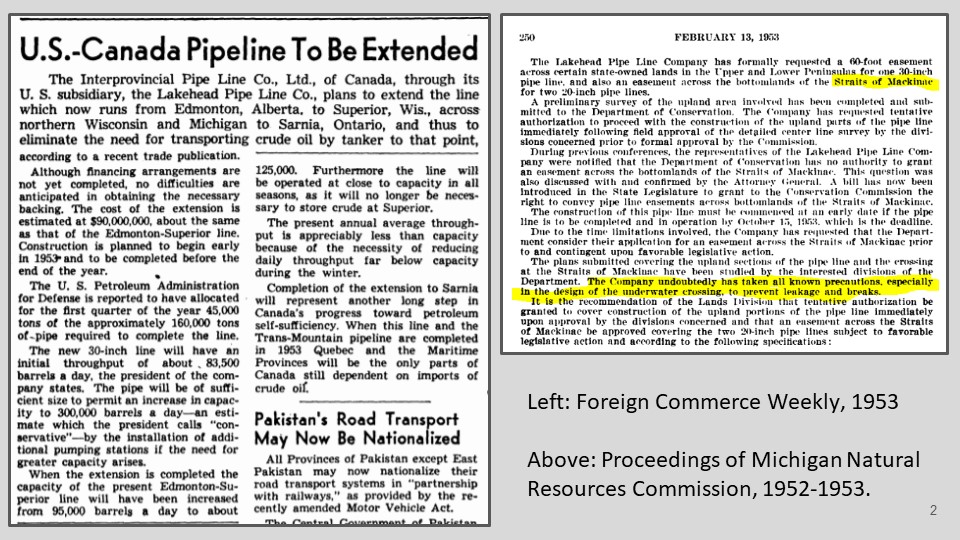
On
the evening of August 15, 1953, a group of people gathered at the shore of one
of the world’s largest lakes for a champagne toast from a set of bleachers. It
was within view of the future site of the Mackinac Bridge, one of the world’s
longest suspension bridges that would finally connect Michigan’s Upper and
Lower Peninsulas after decades of ferry service. But the spectators weren’t
there for the future bridge: they were celebrating the arrival of the first
section of a twin pipeline that had just been been placed underneath a four
mile channel of water at a depth of 250 feet. The arrival of the “North 30”
twin pipeline marked one of the deepest water crossings in pipeline history up
to that time. Aside from a few mentions in industry journals and Michigan’s
legislative record, this milestone went relatively unnoticed elsewhere. And for
the next 60 years, no one really paid attention to the pipeline underneath the
Great Lakes.
I’m
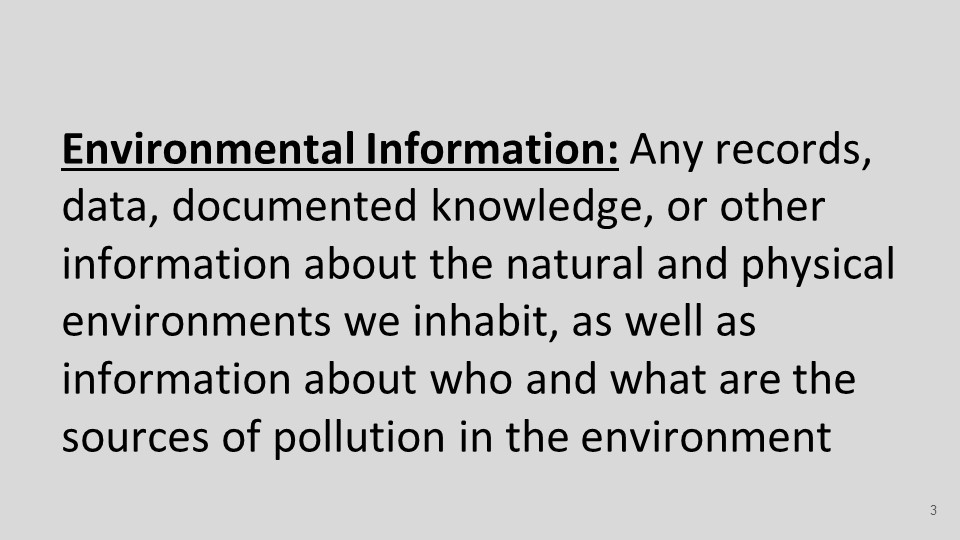
aware that most of you rarely engage with environmental information in your
daily work life, except perhaps checking the weather report to determine
whether to bring an umbrella to work. You’re probably at a library technology
conference because some part of your job description involves using specialized
technologies to organize and make information in your library accessible to its
users.
But
even if it’s not present within your job description, environmental information
impacts your life on a daily basis. When you brush your teeth in the morning,
the water utility that provides water to your residence is part of a larger
infrastructure that generates vast amounts of data that is shared with
regulators. The conditions in which your lunch food was grown, the air quality
of the park that you may visit on the weekend, and the vehicle you used to get
here, are all parts of larger infrastructures, which have reams of environmental
information associated with it that you’ll never read or handle.
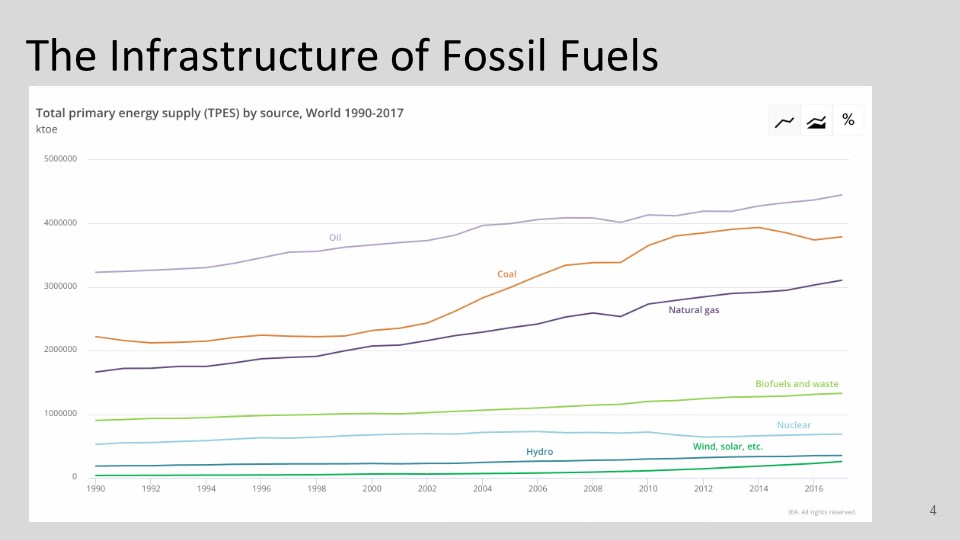
Perhaps the infrastructure that most deeply shapes every
continuous hour of our lives is the one we’re sharing right now, as we sit
beneath these lights and in this climate-controlled room that is powered by the
infrastructure of energy production. The vast majority of energy used in the
world – almost 80% of it – comes from fossil fuels. Fossil fuels occupy a
particularly challenging position at the intersection of infrastructure and
environmental information. Fossil fuels are removed from the earth, undergo
significant processing, and are often transported thousands of miles away from
the point of extraction, thus requiring a worldwide infrastructure for their
use. And for any infrastructure to work efficiently, it requires significant
amounts of data and information for its operation to know where and when things
are coming or going.
So why should those of us here today care about the data of
infrastructures outside of our institutions, for which we have no control over?
And why especially should we care about the information with fossil fuels, which
probably has nothing to do with our job description? I argue it is because
librarians and archivists are uniquely positioned among professions to
understand how the use of information, and the lack of access to it, impacts
communities. Fossil fuel interests in the United States and Canada benefit
enormously from a legal framework that allows them to shelter enormous amounts
of information from the public. This has serious consequences in the short-term
for those who live near the locations of fossil fuel production and
transportation infrastructure, but also for the long-term, since everyone alive
today and tomorrow will be subjected to the consequences of climate change
caused by burning fossil fuels.
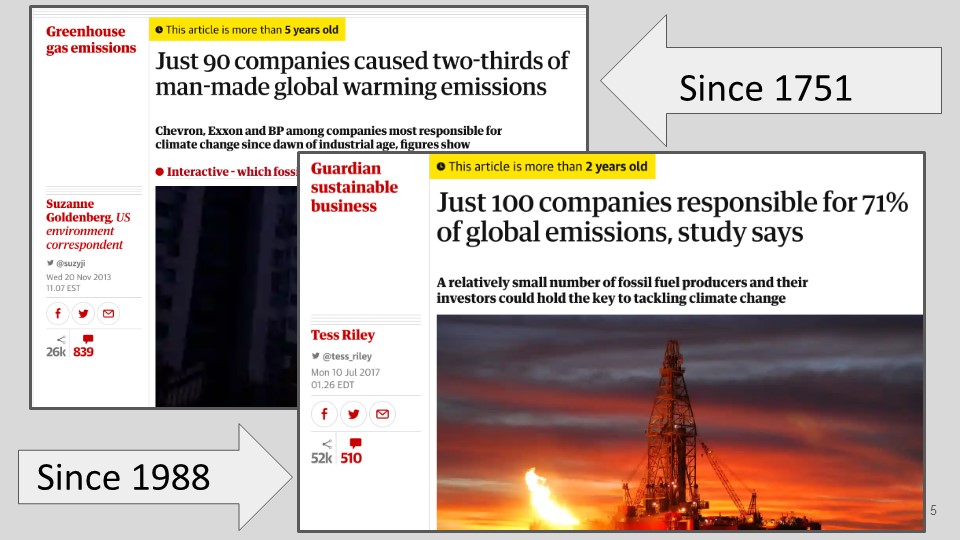
You may have heard the figure that just a few dozen
companies are responsible for the majority of world emissions. If a patron
where you work asked whether your library had information on the business
practices of the US or Canadian companies on that list, what could you tell
her? You might be able to track down annual reports to shareholders or mandated
disclosures to regulators, but what if she wanted information beyond what was
in those reports? The answer is that you would quickly hit a brick wall,
because so much of it is locked up within the companies themselves. And so we
are in a position where in the largest challenge facing humanity today, we
librarians and archivists do not have the means to help others access necessary
information about these companies because so much of it is private. Not only is
this information not in our libraries, it’s often not even in the public
domain.
Fossil
fuel infrastructure has another challenge associated with it: unlike the roads
we travel every day on, its infrastructure is often hidden. It is underground
or in fenced off structures we cannot access. In many cases this is for good
reason: there is not room aboveground, or the exposure of pipelines to the
elements can speed up wear and tear. But the effect of hidden infrastructure is
that many of us do not think about what we cannot see.
When
we cannot encounter hidden infrastructure firsthand in our daily lives, then information about that infrastructure is
the closest proxy we have for being able to observe it. Since most pipelines
are hidden in the landscape, pipeline maps are essential forms of
infrastructure documentation. A consistent difficulty with infrastructure
information is that often times different jurisdictions take radically
different approaches to presenting similar contents.
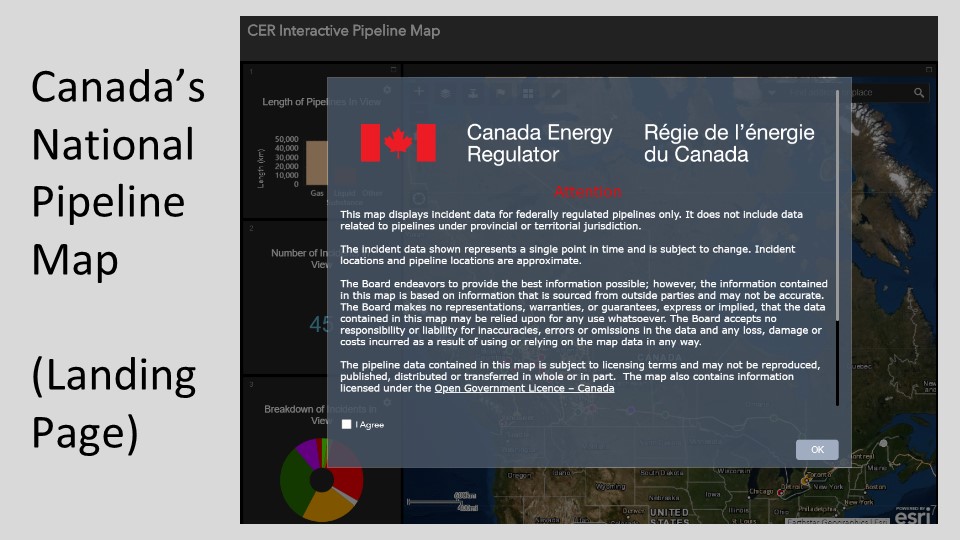
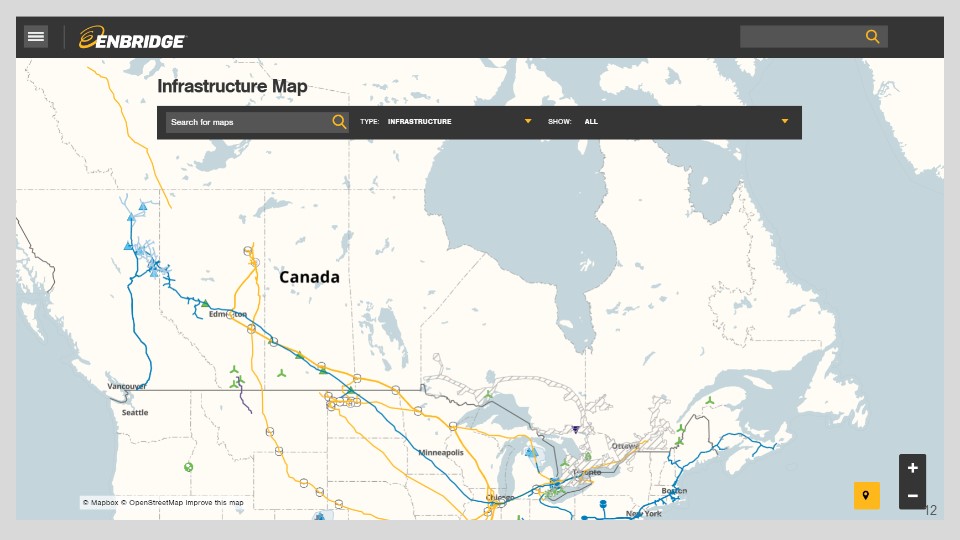
The
United States and Canada both maintain national pipeline map websites, and both
have similar forms of information, but Canada’s map and the United State’s map
involve radically different user experiences. I want to start with this example
because it shows how deeply technology mediates our experience of accessing
information about infrastructure.
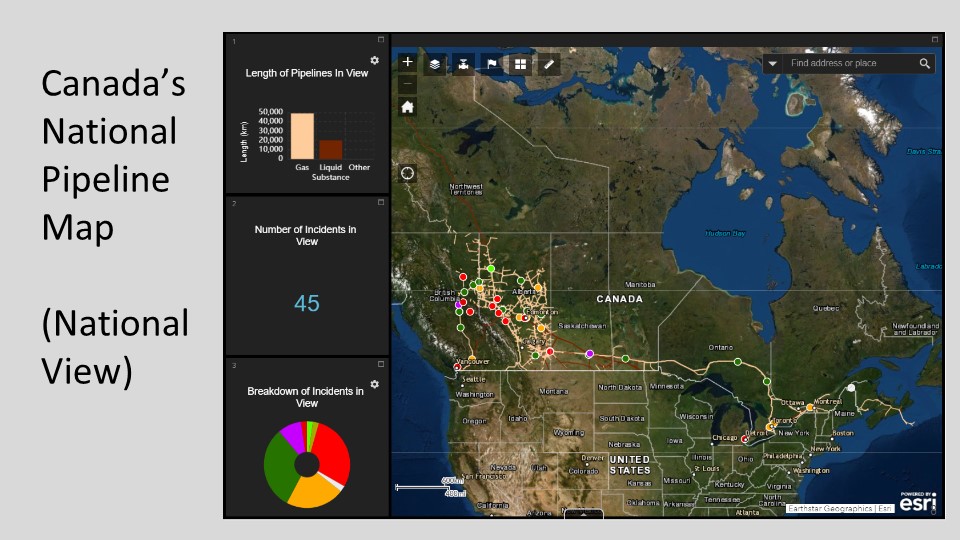
When you start on the Canadian
pipeline map, you get a disclaimer and after saying “Yes I agree”
you automatically see everything and can pan and scroll around.
You can enter an address, if you want, but if you just want
to zoom in and out from Ontario all the way down to a city and back again. You
also get some useful data points on the left hand side about incidents and
pipeline miles.
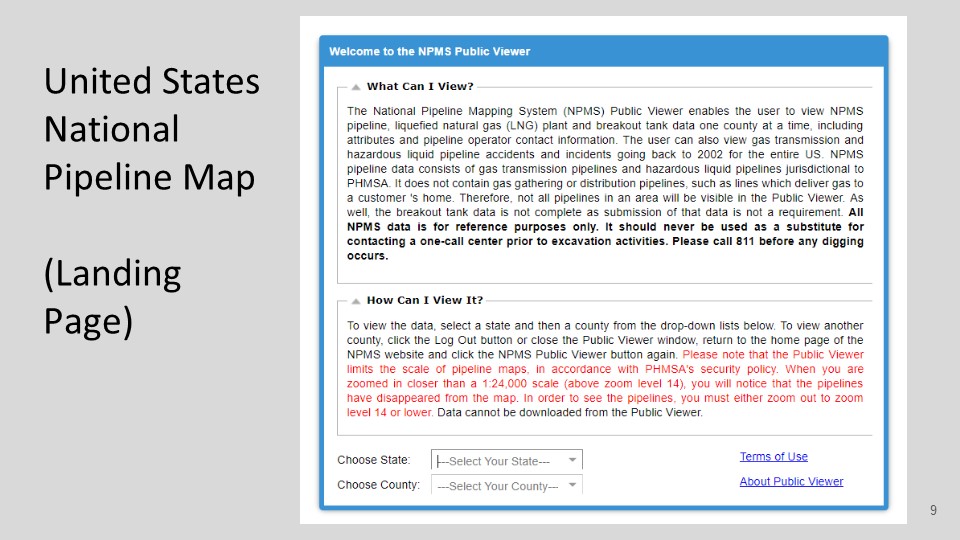
Now, contrast this to the United
States’ pipeline map, which immediately informs you in stern
language that because of security concerns, you can’t zoom in past a certain
threshold. For what it’s worth, this is roughly the same zooming capacity as
Canada, but I appreciate that Canada doesn’t insinuate I might be up to no good
just because I want to understand the geography of fossil fuel infrastructure.
But then, the United States map does something truly weird:
it makes you enter a state and county. This is the first sign that this map is
not designed with the general public in mind. For scale – Ohio itself has 88
counties, and I can only name about half a dozen. What if you want to view a
multi-county area? Too bad – you’re limited to one at a time.
In her talk “The Tool Shapes The Task”, Ursula Franklin
talked about how the tools we use shape the types of work we can do. What the
US map forces us to do by selecting a county is to consider a pipeline only
within the boundaries of a single small political jurisdiction – it doesn’t
allow you to look at the pipelines from say, Ohio to Michigan or Cleveland to
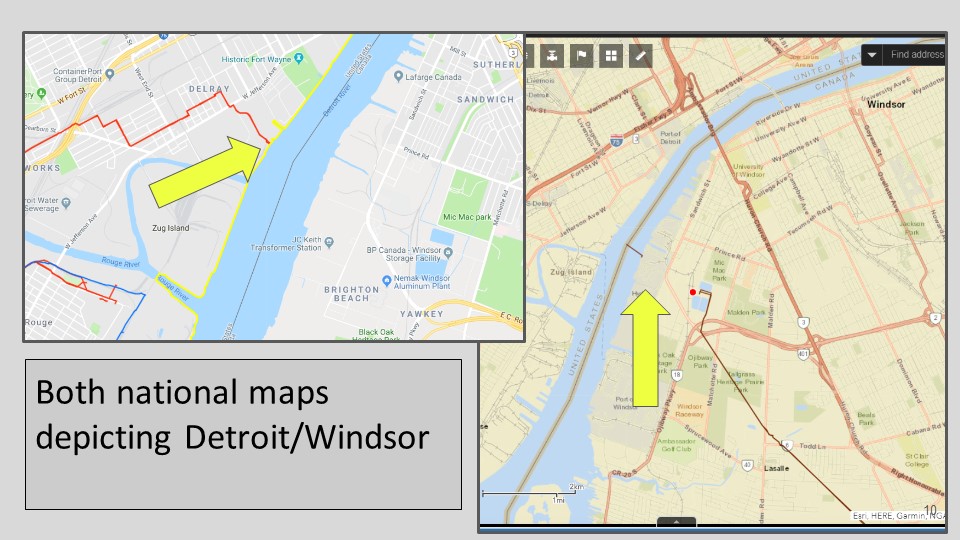
Chicago. The local examples on the slides depict Detroit and Windsor, which are
on either side of the river separating the US and Canada. You’ll notice that
neither map showed how pipelines cross borders – and not only do pipelines
routinely cross political jurisdictions, they also cross watersheds.
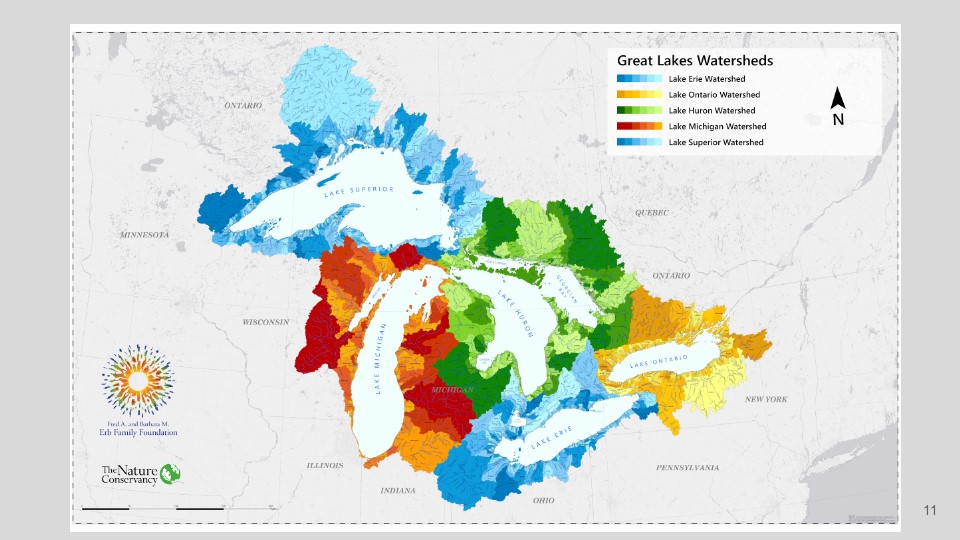
One of the largest transnational watersheds on Earth is the
Great Lakes, consisting of 5 major interconnected lakes spanning 750 miles (or
1200 kilometers). Many people think calling them lakes doesn’t do justice to
communicate how vast they are, and so they are also described as an inland sea. When you stand at the edge of a
Great Lake, you usually can’t see the other side. What you see instead might be
waves. They contain roughly 21% of the world’s surface
freshwater – and about
84% of North America’s freshwater.
Almost a quarter of Canadian agricultural production takes
place within the watershed. Roughly 10% of the U.S. population and more than
30% of the Canadian population lives in the Great Lakes region. The Lakes
region provided the cities in the region shipping routes and water for manufacturing,
but it also provided a convenient place to discharge pollution – leading to
infamous milestones in US environmental history such as Cleveland’s Cuyahoga
River catching on fire – multiple times – due to industrial discharge. Although
environmental law has significantly improved the waters of the Great Lakes
since then, we rarely consider the hidden infrastructure of oil and gas
pipelines that can threaten the largest source of freshwater for the US and
Canada.
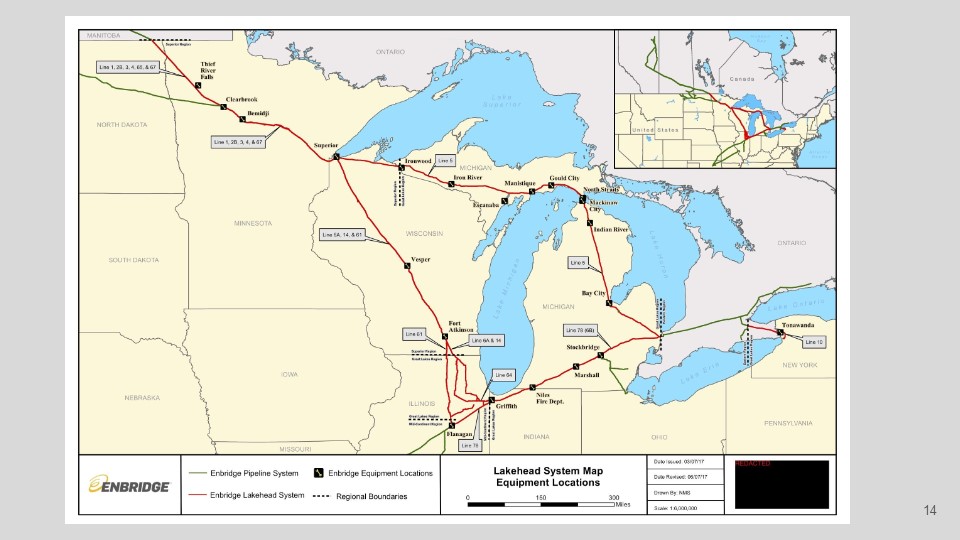
The pipelines around the Great Lakes are directly linked
with the history of oil production in Alberta. The Lakehead pipeline system
around the Great Lakes began being built in the 1950s by Interprovincial Pipeline, which was a
subsidiary of the Imperial Oil Company of Canada, and was the predecessor
company of Enbridge. This pipeline system was designed to transport crude oil that was being produced
in Alberta’s newly discovered Leduc oil fields.
The first phase of the pipeline went from Alberta to Superior Wisconsin. The
company then put oil on tanker ships that crossed the Great Lakes to Sarnia,
Ontario for further refining. But the increasing production of oil – along with
the fact that the Great Lakes iced over every winter – meant that the company looked
to build a pipeline to facilitate transportation. The company considered two
routes – one, an entirely overland route
that would have routed the pipeline from roughly around Chicago to Sarnia – in
other words, on the southern US edge of the Lakes. The second route was one
that ran the pipeline through Michigan’s Upper Peninsula, down through the
Straits of Mackinac, and then through Michigan’s Lower Peninsula, and over the
Detroit River to Sarnia. If you’re wondering whether the company ever considered
a third option – of routing it entirely through Canada – well it never really
did, because it would have cost $10 million more and added an extra 120 miles
of routing.
The company decided on the second option, through the
Straits of Mackinac, because it was the shorter route. Remember, this all took
place in the early 1950s, which was at least a decade before many of the major
US environmental regulatory laws that required serious consideration of the
environmental impact of major engineering projects. As a result, the entire
design and construction process was remarkably swift, beginning in 1952 and going into operation in 1954.
The routing of the pipelines through the Straits of Mackinac
has turned this pipeline into one of the most contested pieces of aging fossil
fuel infrastructure in the United States. In large part, this is due to the
Straits location at the juncture of two of the Great Lakes, Lake Michigan and
Lake Huron. The channel is about five
miles wide, and due to winds, the currents in the channels change very frequently. While an oil spill in
any environment is bad, it would be particularly bad here because the current
changes would make it difficult to model where the oil would go.
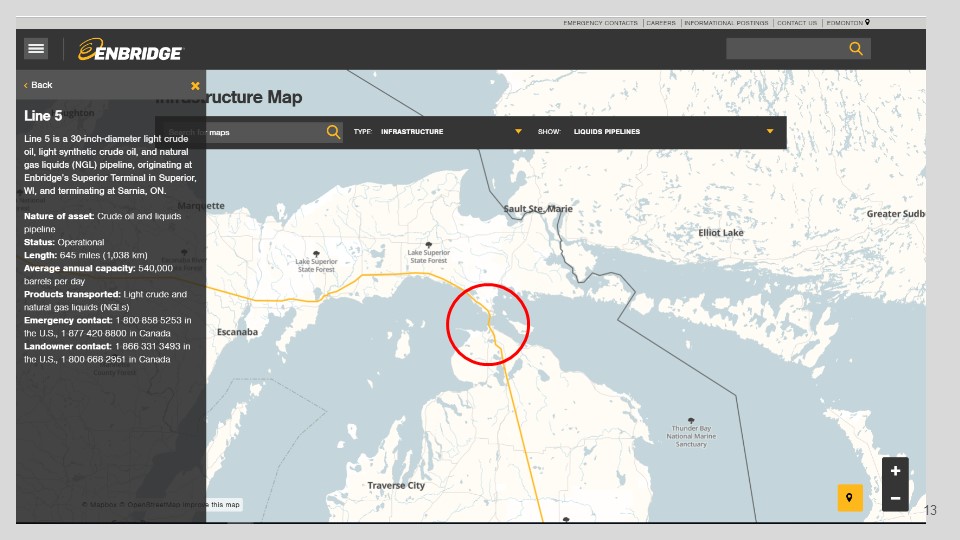
Today this pipeline is known as Line 5. Line 5 has not yet
had an oil spill in the Straits – so why has it become the source of
significant attention?
In 2010, another Enbridge pipeline, known as Line 6B, began
leaking near Marshall, Michigan. More than 840,000 gallons of diluted bitumen
leaked into tributaries of the Kalamazoo River over the course of two days. The
result was that the Marshall spill became one of the largest inland oil spills
in the last several years. If this never crossed your radar, it may be because
the largest oil spill in history was still taking place during the same summer
in offshore Louisiana with the BP Deepwater Horizon oil spill.
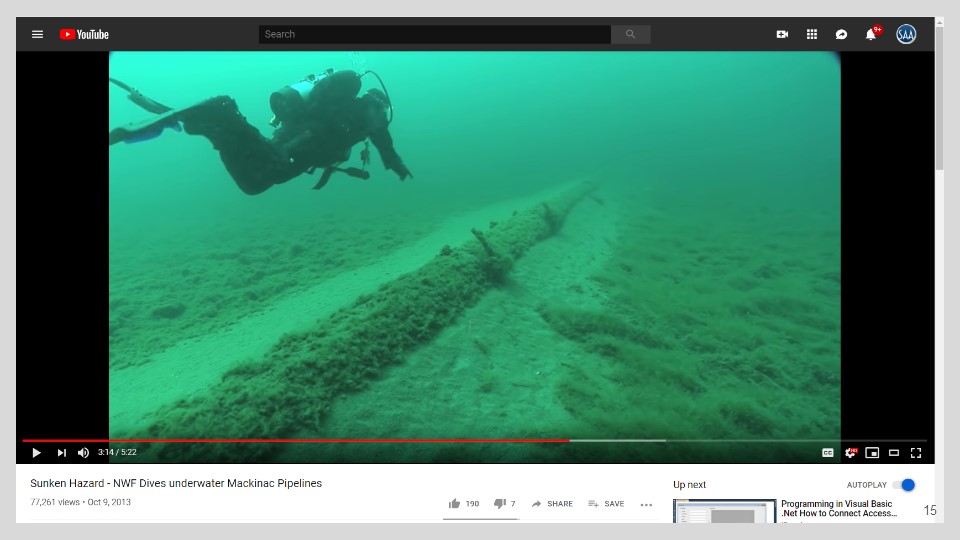
After the Marshall oil spill, the National Wildlife
Federation began drawing attention to Line 5, and in 2013 used scuba divers and
underwater videos to publicly document the condition of the pipelines in the
Straits. From this image, you can see that the pipeline has many mussels that
have stuck to it, which Enbridge claims are not affecting the integrity of the
pipeline – though I would have to imagine they make inspections more difficult.
Following this report, the state of Michigan convened two major state-wide
committees to implement pipeline safety standards and issue further
recommendations. Many of the recommendations involved transparency and access
to information about pipelines.
One
of the most challenging aspects of information about hidden infrastructure is
that it is often deliberately inaccessible to the average person because of who
created it. While the federal government can tell me what pipelines are nearby
and what they carry, only the company operating it could tell me whether it is
currently transporting petroleum, natural gas liquids, or something else.
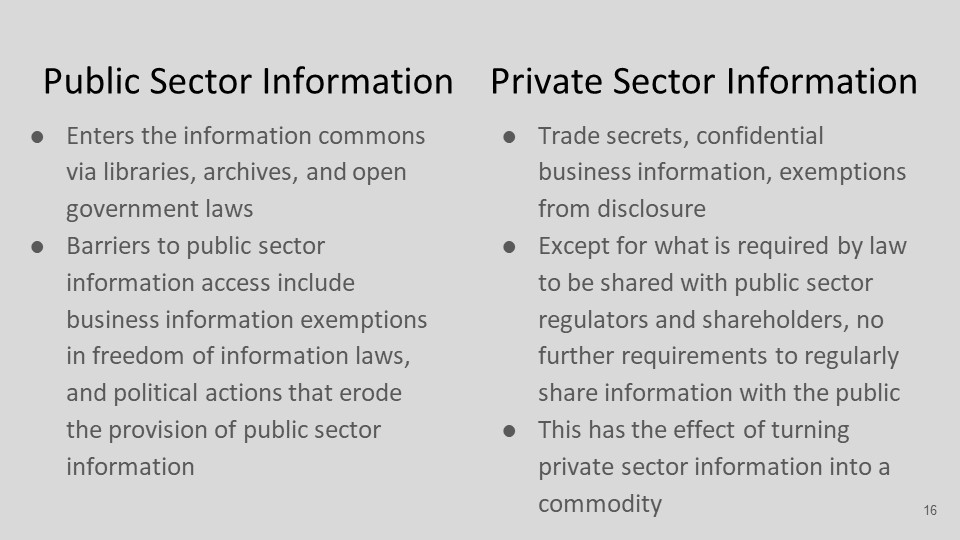
The
provenance, or source, of information often determines whether information is
treated as a commodity – in other words, something with a kind of monetary or property
value that isn’t accessible to all people, or whether it is treated as part of
the commons, meaning everyone has shared and similar rights of access.
By
and large, environmental information created by the public sector in
jurisdictions with open government laws is theoretically available to the
public. I want to heavily emphasize the word theoretically: there are glaring
exceptions to accessing information across the public sector, especially
depending on who has political control. The systematic funding and management
issues of Libraries and Archives Canada, and the Harper government’s 2014
closures of several federal libraries associated with environmental agencies
show that even information held by the public sector today is not guaranteed to
be accessible in perpetuity. Laws matter as well: Canada’s Crown Copyright
application means that government documents are not as freely available
compared with the United States, in which government documents are part of the
public domain.
But
the distinction between public and private sector information provenance is
still crucial: if it’s created by the public sector, there is a larger body of
legal doctrine and precedents across many diverse jurisdictions supporting the
idea of public right of access. Freedom of information laws are not the only
tool that ensure public access to public sector information: the role of
records management in assessing agency records for transfer to archives, or
federal depository programs for government documents in libraries also serve to
move information created by the public sector into an information commons.
In
contrast, information created by private entities is considered a commodity and
not part of the commons. Because of the privileged role that private sectors
are accorded within the legal systems underpinning capitalist economies,
information is treated as company assets that may be sheltered from the public
as trade secrets, confidential business information, or other forms of
protection from disclosure. Disclosure of this information has the potential to
undermine a company’s capacity to maximize profits, by either damaging its
reputation or value, providing fodder for lawsuits, or making it vulnerable to
competitive action. When you delve into legal scholarship on how the courts
regard business information, the classic examples that come up are things like
protecting Coca-Cola’s right to maintain its recipe a secret.
But
where things get quite murky, and from my point of view, very alarming is the
fact that courts are very deferential to business information as a commodity
even when it has serious implications for public interest. Except for
information that corporations must share with regulators and with shareholders,
they are not otherwise required to share information to the public. Of course,
many corporations do voluntarily share information, but voluntarily sharing
information is not the same thing as guaranteed statutory access to it.
In
the world of people who study environmental policy, there is something known as
information asymmetry. This is a way of saying that one party has more
information on a particular issue than another. When it comes to environmental
regulation, often times companies involved with natural resource development
have more information on the potential impact of their activities than
regulators have, which poses challenges for regulators to do their job on
behalf of the public.
Furthermore, regulators have to trust that the
corporation is sharing authentic and accurate information with them, and there
are many examples of companies that withhold information from regulators, both
accidentally and deliberately. When corporations are compelled to disclose
information to regulators, not all of this information becomes public. While
ExxonMobil discloses much information to SEC/EPA, I cannot FOIA everything they
have submitted because there are many confidential business information
exemptions in FOIA.
A
serious example of an information asymmetry took place when Enbridge officials
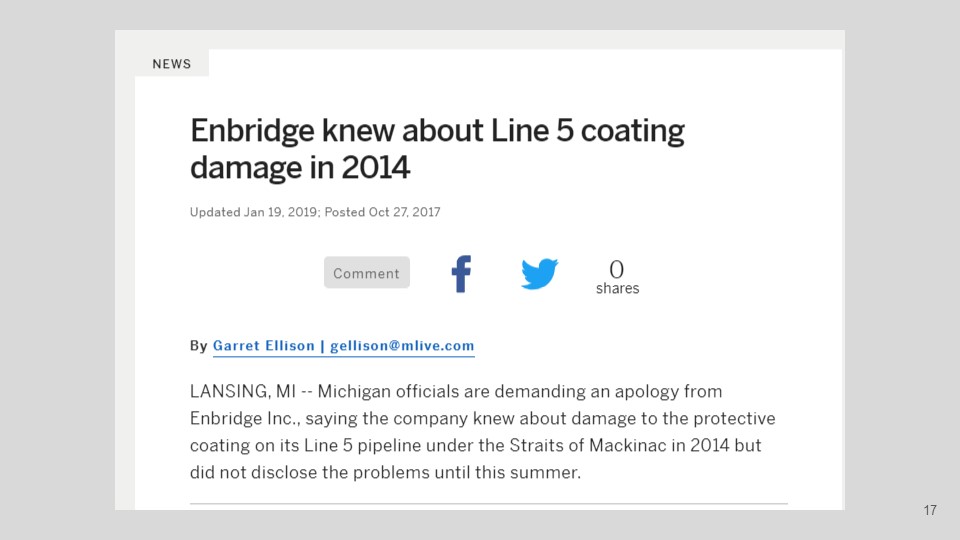
misled the state about the protective coating on the pipelines in the Straits.
In March 2017, the Michigan Pipeline Safety Advisory Board asked Enbridge about
the protective coating on the pipelines in the Straits, and the company told
the board it was “intact.” However, five months later information came out
showing that Enbridge knew
as far back as 2014
that there were gaps in the coating, resulting in the state ordering Enbridge
to conduct an investigation.
Information
asymmetries have also arisen with Enbridge not sharing information with
indigenous governments who have treaty and consultative rights to the land and
water through which Line 5 runs.
Dozens
of tribes in the Great Lakes region have issued statements against
Enbridge Line 5, and a few of them are beginning to initiate legal action
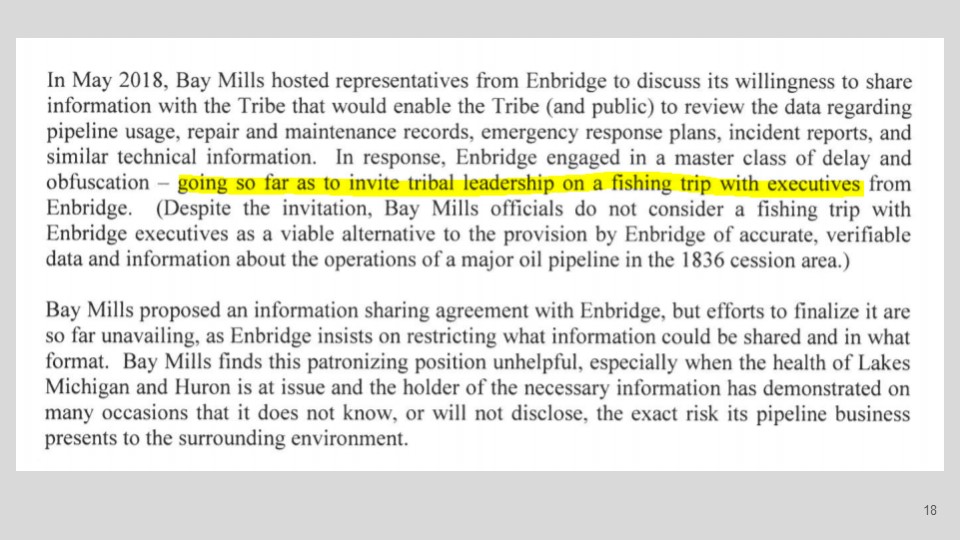
against the company. The Bay Mills Indian Community in Michigan has repeatedly
sent requests to Michigan’s state officials and Enbridge requesting that the
company share the same information it does with other government officials.
According to tribal leadership, when they attempted to meet with Enbridge in
May 2018 to discuss information sharing, the company executives invited them
instead on a fishing trip. The tribe noted that a fishing trip was not exactly
a viable alternative to sharing information.
There
is often a temptation to try to solve information asymmetry issues with
technology. There’s a prevailing sense that building a website or making a data
set available to download is the same thing as transparency.
This
is the “just add technology” theory of transparency, a theory that avoids the
messy political question of what information exists in the commons and what
information has been commodified but is of public interest. It also often
sidesteps questions of maintenance, such as whether funding and staffing will
be allotted to ensure that any technology used in the service of transparency
delivers on its promises. The “just add technology” theory of transparency can
be seen in the state of Michigan reports – if you read them carefully, it is
clear that there is not consensus around increasing the legal means to make
information available, but to use technology to make already existing public
information from the state more accessible. Perhaps this is because both of the
committees that existed between 2015 and 2018 included representatives of the
energy industry.
The
main transparency initiative that was actually carried out as a result of the
two reports was the creation of a website, mipetroleumpipelines.com, administered
by two of Michigan’s state agencies.
In
the board’s final report, the recommendation pertaining to the website stated
that the website would continue to be maintained through at least 2020. The
recommendation suggested the website should have maintain maps, educational
guides, legal primers, and “updates on the future of Line 5.”
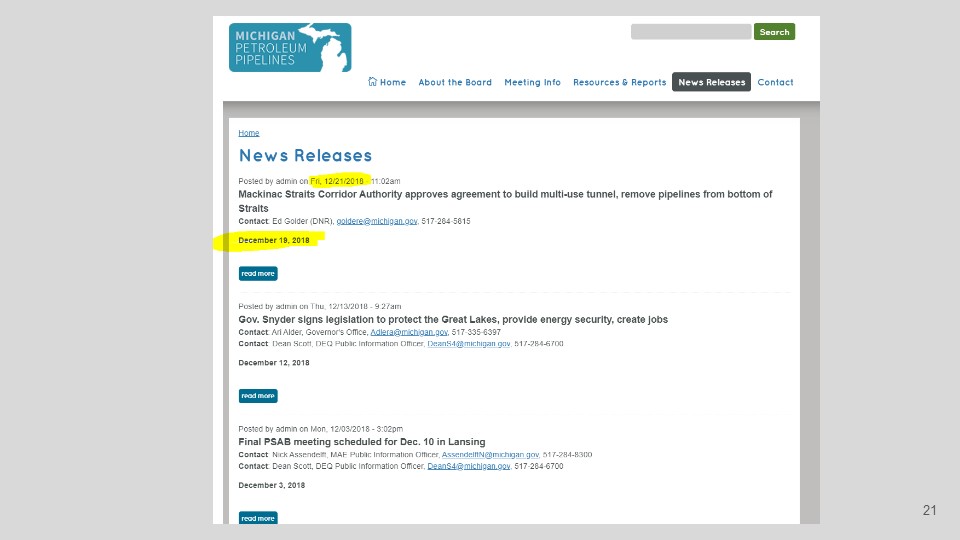
The
2018 report was submitted on December 20, 2018. And this appears to be about
the last time anyone thought about updating this website. The last news release
on the website was posted the day after the final report, December 21. There are no maps. There is no
information about the current regulation of pipelines in Michigan. There are no
education primers. There are no links to major cases.
But
perhaps what is most concerning is the lack of Line 5 updates – and there have
been scores since December 2018. Less than 2 weeks after the Pipeline Safety
Advisory Board submitted its final report, new state government leadership was
sworn in, including a new governor and attorney general who campaigned against former governor Rick Snyder’s
plan for maintaining the pipelines in the Straits of Mackinac by building a tunnel
over them. Earlier this summer, the attorney general filed a lawsuit to shut
down the portion of Line 5 in the Straits.
Despite
many of these developments within state government – there is not a single
update on the website showing anyone has worked on it in 2019.
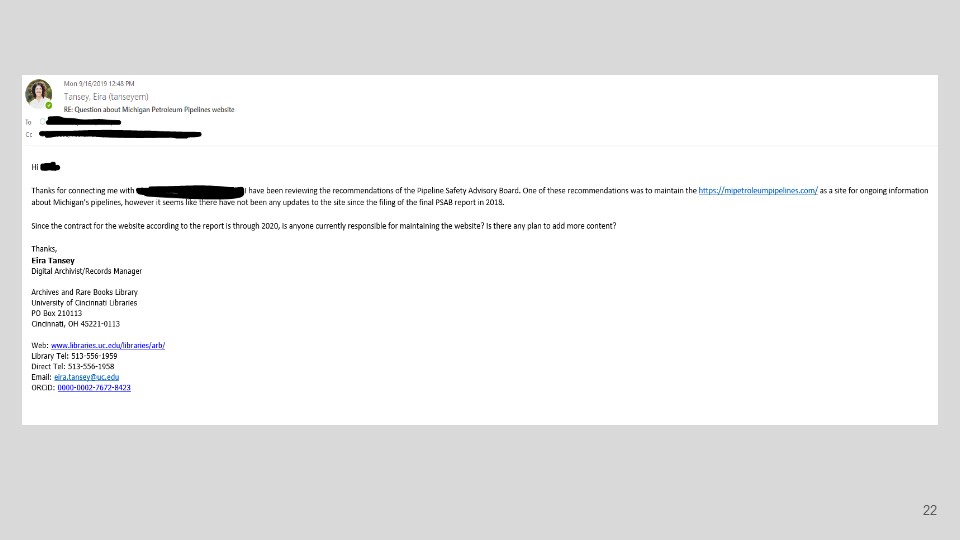
I
emailed the Public Information Officer of the Michigan Agency for Energy on
August 28 to ask when the website would be updated, and was referred to two
other individuals. Despite following up, they still have not responded to my
follow up emails.
Finally,
I want to show you how ultimately political power is the key question to who
has information they’re willing to give you.
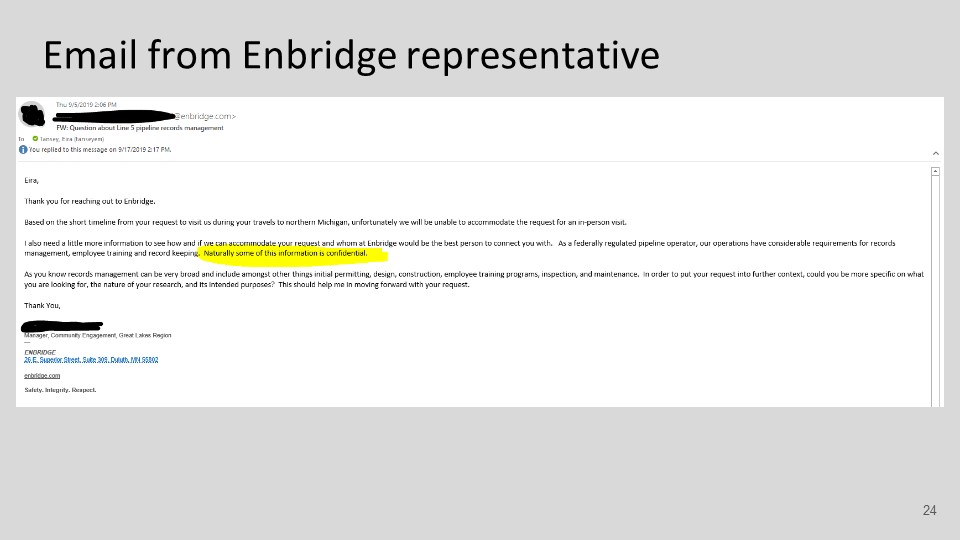
If
you look at Enbridge’s website, it has this very glitzy page that says “Communication is a two-way street. We want to
hear from you, and address any concerns you may have about our pipeline operations.”
Well that sounds promising!
Unfortunately,
a two-way street apparently includes some dead ends in Enbridge’s world, as I
have been going around in circles with their PR representative asking for
information.
Second,
even entities developed to serve the public are not great about making
information available, if it’s not part of their mandate. Within the world of
environmental regulation, transboundary issues are often managed according to
legal compacts or agreements between different political jurisdictions. The
Great Lakes Commission was created in 1955 due to the Great Lakes Basin Compact. It has 8 member states and the
provinces of Ontario and Quebec are associate members. The commission is
responsible for coordinating the “development, use, and conservation” of water
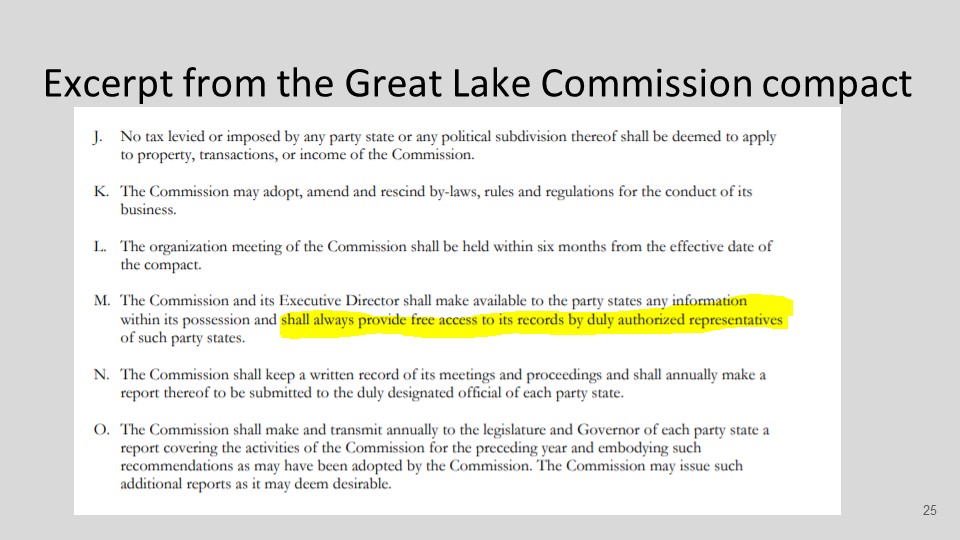
in the Great Lakes watershed. As an interstate compact, the commission is doing
work on behalf of the public, and yet there is not a way to file a public
records request with the commission, and the compact’s own language reserves
the right to access records only to member state’s designated representatives.
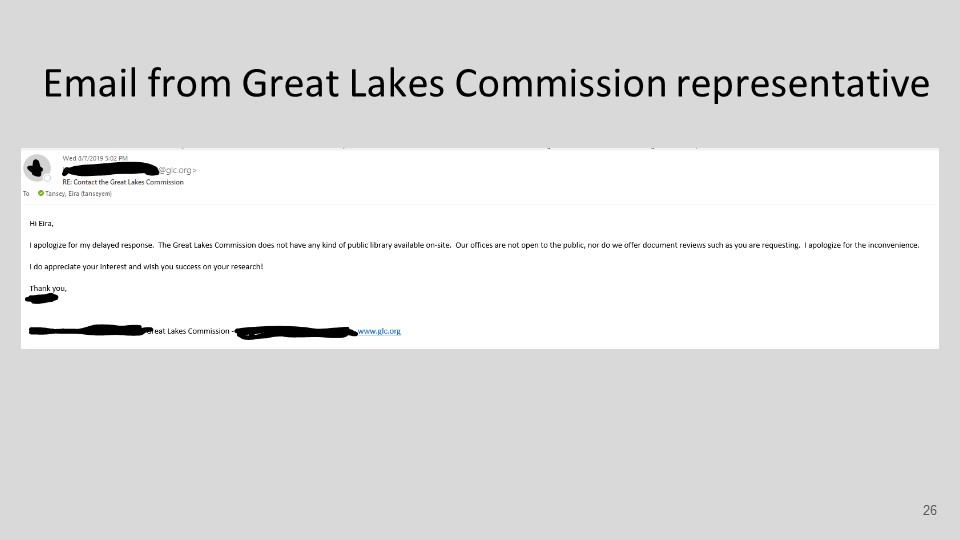
I
wanted to review the Commission’s annual reports from around the time of the
Line 5 construction to see if there was any discussion of the pipeline
construction. I emailed with GLC several times, and even offered to visit their
headquarters in Ann Arbor but was ultimately told: “The Great Lakes Commission
does not have any kind of public library available on-site. Our offices are not
open to the public, nor do we offer document reviews such as you are
requesting.”
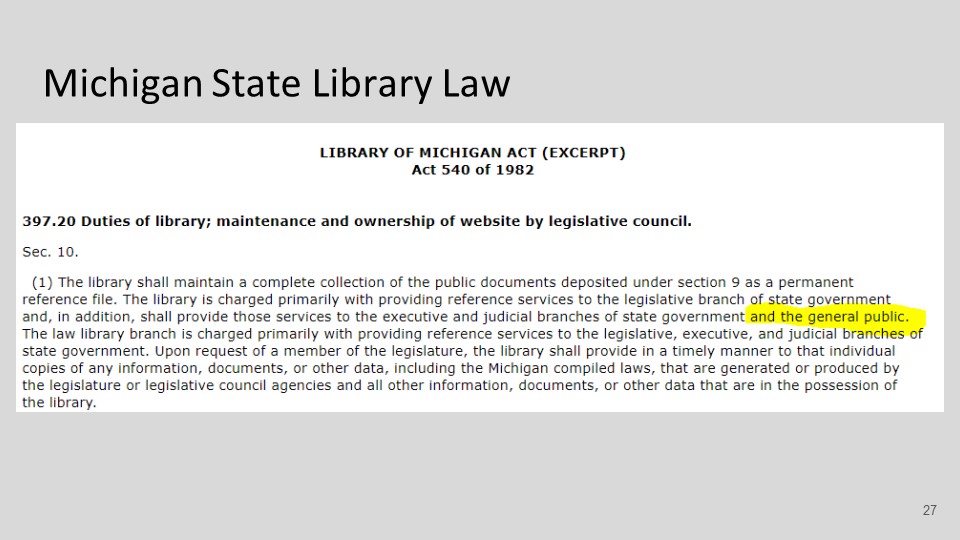
Luckily,
I did find someone willing to share information with me, and that is the State
Library of Michigan. Under a law passed by the state in 1982, the Library has a
legal mandate to preserve state documents for public access. I started poking
around the Michigan state library catalog a few months ago when I was planning a
research trip to the state. I only had a few hours to spend at the library, but
there were dozens of documents I wanted to review and knew I wouldn’t have time
to pull. On a lark, I emailed the reference librarians to ask if it would be
possible to pull everything I wanted to look at in advance, and they were kind
enough to have a fully-stocked book cart waiting for me when I arrived.
Now
I’m sure that the people who work at Enbridge and the Great Lakes Commission
are also very nice and probably want to be helpful. But the difference between
them and the State Library is that only the latter is required, by
law, to serve the public. And so it is ultimately political power that gets
information into the hands of the public.
As
we confront the challenges of accessing information around pipelines and oil
production Canada and the United States, it is worth zooming out to consider
the fact that both states arguably operate as petrostates. By petrostate, I
mean a state in which the production and use of fossil fuels is so critical to
both its economic activity and its political elite that any suggestion to
transition to non-fossil fuels is viewed as a threat to its way of life. The
energy markets between the United States and Canada have long been very
closely-linked, and the logic of petrostate politics is everywhere on either
side of our border.
In 2018,
the United States was the largest producer of oil, and Canada was the fourth
largest. Both countries supply most of their own fossil fuels, but when we do
import, it is typically from the other. Canada has the third-largest oil reserves in the world. The
United States has the fourth-largest
natural gas reserves in the world. By all accounts, the amount of fossil fuel
production in both the United States and Canada is increasing, at the exact
moment scientists tell us we need to
move in the other direction. Petrostate ideology requires certainty that these
future projections will not be altered by a concerned, outraged, and informed
public, to the point where it pathologizes anyone it perceives is an enemy. You
can see examples of this everywhere such as the Alberta Inquiry dedicated to investigation of alleged foreign funding of environmental activism, or the
increase in US legislation that would increase criminal penalties against
nonviolent pipeline protesters.
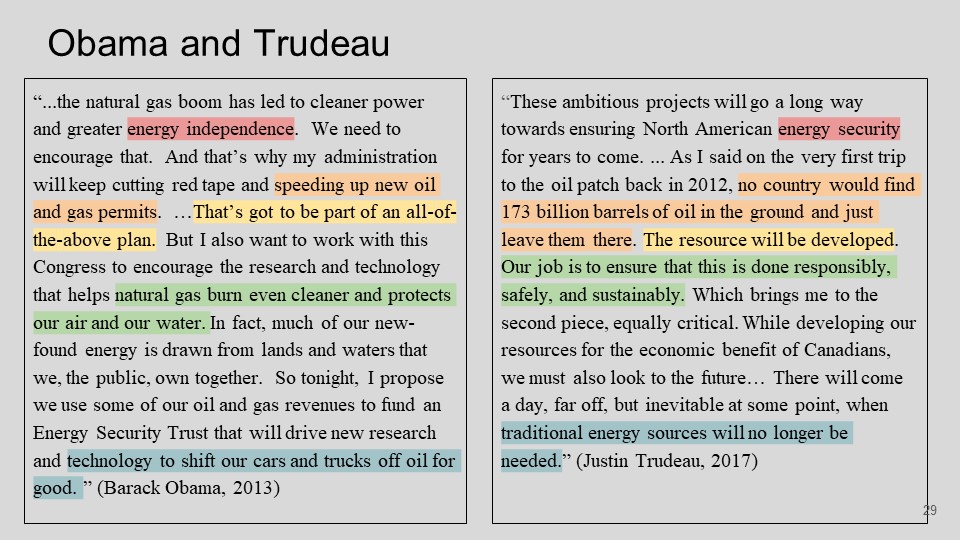
In
a petrostate, the logic of fossil fueled capitalism is so strong, it even allows
allegedly progressive leaders to occupy remarkable heights of cognitive
dissonance.
Barack
Obama famously bragged about speeding up oil and gas permits as an “all of the
above” strategy, and Justin Trudeau claimed “no country would find 173 billion
barrels of oil in the ground and just leave them there.”
I
bring up these examples to point out how deeply embedded the logic of
protecting the petrostate is, even among politicians who acknowledge the
reality of climate change. The petrostate is so powerful because of how it
systematically hides not just its infrastructure but the information about its
infrastructure. If the information about its infrastructure and operations were
more easily available to the public, that information could and would be used
against it, both in the court of public opinion and potentially, in an actual
court of law.
So
where does this leave librarians and archivists in the world of petrostate
politics? There are a number of things we could do, and I could list them on a
final slide for you, but I think that’d be a little too easy. The challenge
ahead is immense, and a to-do list seems a little too superficial for what we
have ahead of us. Instead, I’d like for us to consider a serious shift in how
we view our professional identities so we can consider how to better serve the
public.
One
of my eternal concerns with librarians and archivists is that we define our
professional identities by the tasks we perform for our employers, as opposed
to the fundamental nature, and importance, of our work. We repeat the things
that our employer has placed in our job ads, such as, “I develop retention
schedules for my university” or “I run checksums on the files ingested into the
digital preservation repository.” What is more rare is for us to discuss our
work in a way that evokes our trade; that is, that regardless of our title, we
are ultimately all information workers.
When
we identify too closely with the specific duties of our job descriptions, we
let our employers define our professional identities – and therefore our
professional responsibilities – for us. Furthermore, identifying as an
information worker allows us to extend a critical lens to how information is
stewarded outside of the institutions we work in. In the United States, the
advocacy of healthcare workers for single payer healthcare has become a
powerful force, as these workers have a unique moral and professional authority
when they call for access to healthcare as a universal right regardless of the
ability to pay. We need a similar advocacy effort of information workers to
insist on the decommodification of information; that information in the public
interest should be accessible to the public – even if it was information
created by the private sector.
As
librarians and archivists, everyone in this room has unique skills you can
bring to whatever environmental justice issues are taking place wherever you
live. I have been involved in a number of local water issues in my hometown,
and because being an information worker is such a core part of my identity, I
have used my skills as an archivist to track down historical reports and data
to bring to public hearings to enter into the official comments. If you know
how to work with a library catalog, or large messy data sets, or data
visualization, you have some of the most prized skills that environmental
justice organizations wherever you live desperately need help with. If your
province or state is considering changing regulations that would impede access
to environmental information, you have the professional credibility as an
information worker to speak out and organize your fellow information workers to
stand against further commodification of information. Perhaps one day, we can
create a binational group of information workers dedicated to tactics that
prioritize the decommodification of environmental information and expropriation
of environmental information from the private sector.
Sometimes
we will fail to get information that we need, and then we will need to learn
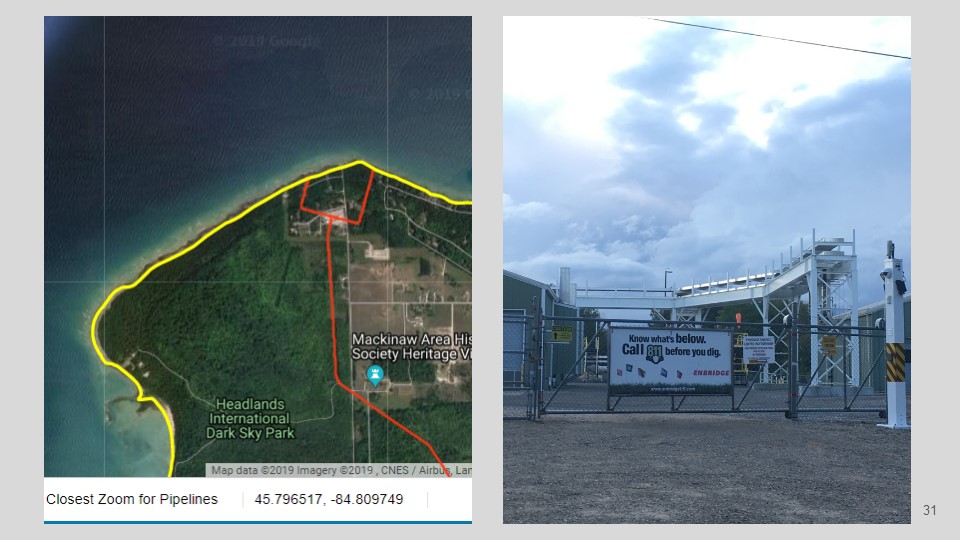
other creative ways of obtaining it. A few weeks ago, I spent some time camping
in Michigan near the Straits of Mackinac. You’ll recall that it’s impossible to
get the specific location of pipelines because you can’t zoom in all the way.
And while technology shapes how we understand infrastructure, it doesn’t always
have the final say, especially if you learn how to read the landscape.
I
wanted to get as close as I could towards near where the pipeline was in the
straits and where it came on land. I looked at the map and saw that the nearest
landmark was a lighthouse near the shoreline. On the way to the lighthouse, I
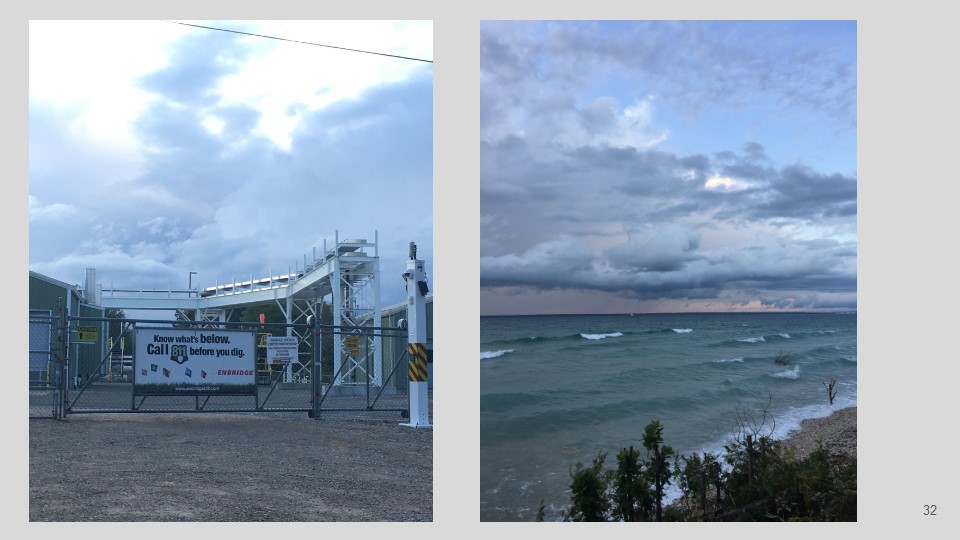
found an Enbridge power station.
I
drove down to the water just over the hill to see if it was possible to see
where the exact point was that the pipelines went from the lake bed into the
shore line – I knew they would be buried but figured there would be a marker
post. I found a woman and started talking with her, and she pointed down a few
hundred feet to say that the pipeline markers were there. The water has been
very high on the lakes lately, and I didn’t think it was safe for me to go further.
So
I went back to my car, drove back up the hill, and turned off to the road going
behind the power station. And finally I found where the pipeline was – not
because it poked out of the ground, and not because of any large sign, but
because of who was on top.
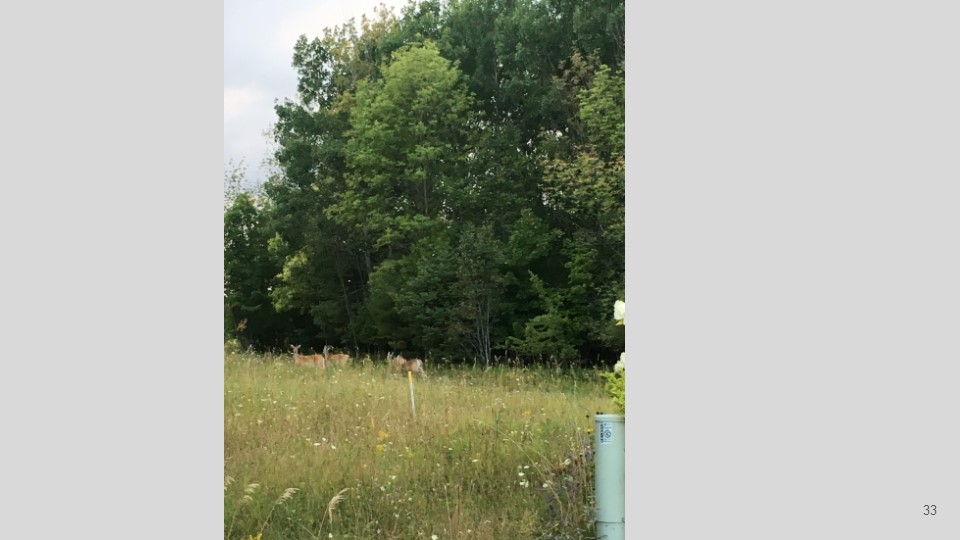
A
family of deer was nourishing themselves on the grassy meadow growing on the
right of way above this pipeline that many people view as a ticking time bomb .
And as I looked at the deer closer, I could just make out a post marker hidden
in the meadow grass.
Sometimes
there is no way to get information about the environment because of the system
we live in which says that corporations have more right to make money than your
right to know what is happening to the hidden infrastructure all around us. But
even with this petrostate logic, there is no substitute for paying attention to
the land, and the air, and the water around us. Sometimes despite the logic of
commodification, the information is right in front of you if you know where to
look.
Comments Off on What We Don’t Know About What We Can’t See: Information and Hidden Infrastructure
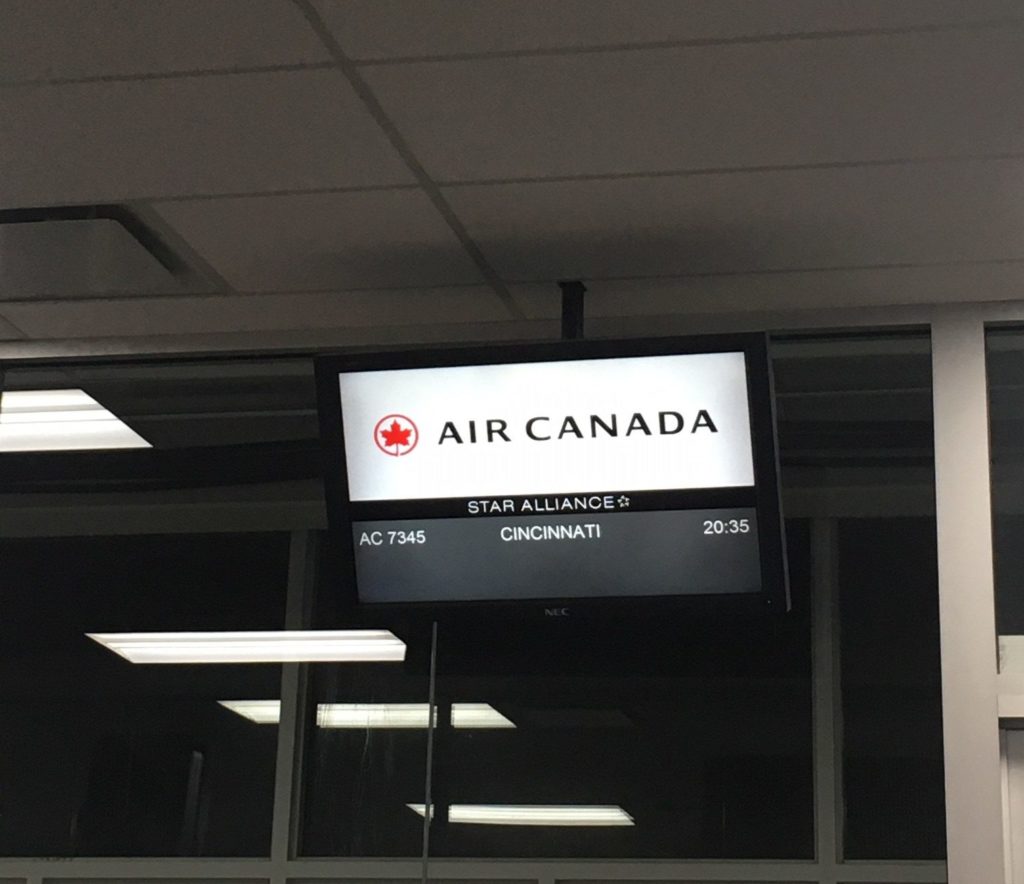
Currently I am at the gate of Toronto’s international airport waiting to board my flight back to Cincinnati. I spent my morning chatting about my adoration of Ursula Franklin with librarians at the University of Alberta, two days after I got on a microphone and did a very radical (for me, at least) keynote to open up the Access conference in Edmonton. In between I saw men lining up to fly out to Fort McMurray which is the epicenter of Canada’s oil and gas extraction, and I crossed what felt like endless points of surveillance to get back into my own country. In the line before US Customs and Border Patrol (something I feel like we don’t talk about enough is how the omnipotence of the US surveillance state asserts itself even in foreign airports), the woman in front of me was juggling two kids, one of whom was so tearful and she was handling them with such quietly frustrated stoicism that I secretly hoped this woman would somehow be on my next flight solely so I could buy her a shot of liquor. And this trip was the sixth I’ve taken in the last month – over the last several weeks my shamefully disgusting carbon footprint that I incurred, at the same time children half and sometimes even a third my age poured into the streets bearing witness to the horrors of climate change, has taken me to all five of the Great Lakes watersheds, Red River Gorge, Chicago, Salt Lake City, and Edmonton. Most of this was professional-related travel, but when your work involves existential dread its sort of hard to shed the archivist perspective especially when contributing directly to it with the fossil fuel use inherent to the majority of transportation methods.
Tomorrow I’m heading back to my office tomorrow where I have a number of emails waiting for me from high levels of the university asking for advice/meetings regarding our various records policy that I haven’t gotten to yet because I have been on my first month of academic leave (i.e. sabbatical) for the last several weeks.
I have been reporting to a full-time archivist job every day on a regular basis for the last 11 years of my life. That goes back to when I had just graduated from college. And before that, the only time I wasn’t working at least several hours a week part-time since I was 16 or 17 was when I studied abroad briefly for a semester (in England) and several weeks (in China).
This summer I was awarded tenure and I was also granted academic leave, the UC version of sabbatical. I get to take my six months of leave in alternating months where I’m in and out of the office starting in September 2019 and culminating in July 2020. This will be the longest period of time in my life when I’ve been able to be away from the office and still gotten paid. One month in, its still a bit hard to wrap my head around.
During the last several months I have been profoundly aware of the major fortune and privilege in having both tenure and sabbatical available to me. I’ve been having a continuing sense of “I feel so lucky to have this and also every worker deserves access to these things” and then I remember tons of workers don’t even have access to health insurance, paid sick days and paid vacation.
When I submitted my application for my academic leave, I outlined two major projects to work on. During this first month, I didn’t get as much done on those because I was so focused on writing a very good keynote for the Access conference in Edmonton. I felt Extraordinarily Guilty and Freaked Out about this towards the end of September – shit, I was turning into the embodiment of every conservative’s worst stereotype of lazy academics who take sabbaticals. This in spite of the fact that I was writing more than 500+ words a day for my keynote (or later on, spending hours editing it, reading more source material in the form of environmental impact assessments and legal opinions, and rehearsing it several times).
In the months leading up to my leave, I was incessantly angling for advice on how to spend my time. One colleague told me she tried to work the same number of hours she did while in the office but allowed herself the freedom to do her hours whenever. Two separate acquaintances told me they didn’t anticipate how much they would miss the social contact that comes from reporting to an office every day. A retired professor Friend from my Quaker meeting pulled me aside one day after meeting for worship to advise that I should go nowhere near campus during the first stretch of my sabbatical, or otherwise it would be like the bat signal going off that I was available for whatever problem had cropped up in my absence. One of the articles I read from the AAUP (disclaimer: AAUP is my union) website lamented how sabbaticals had been appropriated by much of the same neoliberal logic as the rest of higher ed, and that in the quest to make their sabbaticals the height of productivity, folks had lost sight of the root word of sabbatical – sabbath and its inherent connotations of the spiritual and ecological needs for rest.
Despite my usual orientation towards demanding that rest and time for restorative reflection is a basic human right and something that workers must assert their rights to both collectively and individually, I have a difficult time allowing it for myself (I suspect because I struggle so much with the fact that something like tenure + sabbatical, or its equivalent, is such a rare status for the vast majority of workers. Can I still identify as a worker when I have such privilege?). Towards the end of sabbatical month one, I read two books that profoundly moved me and ultimately helped me reframe my fretfulness around the fact that while I had been working very hard this month, I had made less material progress on my original project proposals than I would have liked.
A friend had given me a copy of Terry Tempest William’s Refuge a few years ago when I was dealing with a very difficult stretch of health crises involving my elderly father. I’d read a little bit of Williams’ writing before, but I finally plucked this off my bookshelf because I was heading to Salt Lake City for a family wedding and I enjoy reading books that are set in areas where I am visiting. Williams’ book is a memoir of the deaths of several women in her close-knit Mormon family, and much of the book focuses on how she supported her mother dying of cancer. The book is set against the historic flooding of the Great Salt Lake and the devastation of a bird sanctuary at which Williams, a naturalist, had long sought refuge. Homages to different bird species are woven into every chapter.
Shortly before I started Refuge, I had been provoked into something of a state of deep existential despair and ecogrief. I’ve been working on issues around climate change for a few years now, and I usually do a pretty good job of managing my emotions so I can keep doing the work. I think what probably set me off was some of the research I was doing for my keynote, where I began listening and reading to Albertan oil and gas industry publications and podcasts. One of the very curious things about Canada’s oil and gas industry is that it acknowledges the reality of climate change more than its US counterparts – which then requires it to engage in even more brazen displays of rationalization. So Canadian oil and gas propagandists will tout their “ethical oil”, or claim that their oil and gas is much more environmentally friendly because of improvements in extraction methods. I think the thing that actually triggered this particular wave of despair was a podcast episode in which two very intelligent women chirped that Canadian oil and gas would be a strong player through 2040, that it would be “part of the climate change solution” and that carbon capture and sequestration would ensure Canada’s oil and gas would have a long future ahead. And that’s when it really shattered my heart in a way only my brain had been able to handle before, that these motherfuckers know the car we’re all stuck in with them is going over the cliff and they’re slamming their foot on the gas while telling us it’s not going to be that bad of a drop.
Perhaps that’s why Refuge finally opened the floodgates I so badly needed to let my anger and grief pour out of me. Williams’ knew her mother was dying a horrible death, amidst the fearfulness and denial from her family members and the loss of the natural landscapes she relied on for solace, and all she could do was to be very, very present for it. When I can pull myself out of my grief and despair, this is what I remember: that for years I have felt a calling to do work around climate change using whatever outlet I can find, and the downside about a calling is once you realize it’s there (or what some Quakers refer to as “the still small voice”) and it’s not going anywhere, you can’t walk away from it.
During the end of my sabbatical month I also read Jenny Odell’s How to do Nothing. I had run across Odell’s work first as a visual artist and have always wanted to buy one of her prints of collections of stadiums or industrial waste ponds. How To Do Nothing is kind of a hard book to explain since it’s sort of meandering in the best possible sense of the word. Odell builds a multi-layered and multi-lens argument calling for us to radically rethink how we pay attention to the people and things and beings and landscapes that surround us, but which technology and capitalism train us to very much ignore.
Reading How To Do Nothing made me realize that in fact my first month has been profoundly essential to my sabbatical work, even if its not quantifiable in the normal neoliberalized measures of attention productivity. I realized that what my first foray into sabbatical leave has given me is the recovery of my attention span, which is going to be critical to any further work I do over the next year (I would be remiss if I didn’t mention I also mostly stayed off social media this month, which undoubtedly helped with the repair of my attention span). I was able to read for hours at a time (including difficult and dense law reviews!), and dwell on a particular idea for days at a time by being able to unplug from email and maintain a flexible schedule. Under my normal office schedule, I usually work from 8-5 and am strict about not working after 5 in order to protect the other time chunks of my life. During this month it was not unusual for me to stay up till midnight reading about things relevant to my professional interests, or to be able to go on a much longer morning run than usual because I wasn’t required to be in my office at 8.
For a long time I’ve had a very strong sense that while as essential as this time is to my continued health on several levels, it is still incumbent on me to use it responsibly. I am trying to avoid the usual impulse here to bow down to the managerial perspective of trying to quantify how Time X off produced Y amount of things (though the reality is I am going to do that anyway, both because I have to per the requirements of my leave and because I’d like to ensure I maintain a good chance of being able to take academic leave again). I’m thinking instead along the lines of, “how can this sabbatical help me make more of my work available to the public? how can I use this time to expand my mentoring skills? how can I develop resources that will be of use to the larger archival community?” I’m excited by the potential for the next several months.
One of the many things that library school did not prepare me for was how to do effective peer review. The economics of peer review is that the more you write, the more you get asked to read other people’s work, either informally or formally (I define informally as when a friend or acquaintance asks me to look at something, formally is when a third-party like an editor asks me). As I’ve been reviewing more and stepping into some temporary editorial roles, it’s made me wish there was better guidance for archivists how to do peer review. I’ve often thought about how I could turn one of my reviewer or editor’s reports into a tutorial, but that would be a major breach of confidentiality. However, a timely event that shows how important peer review is just presented itself days before the Society of American Archivists annual meeting in Austin.
As I was packing for the trip to Texas, a friend tipped me off that the big chatter on Archivist Twitter was Frank Boles’ pre-print in American Archivist. The pre-print will be the subject of a lunch time discussion forum at the annual meeting. Having some skepticism about Twitter in general, I decided to print off Boles’ article and tuck it into my luggage to read and draw my own conclusions on the road down.
As full disclosure, the only thing I’ve published so far in American Archivist (AA) is a book review. I’ve been emailing with the current managing editor Cal Lee about something I’m thinking of submitting. And on the other side of the process, I have done peer review for the journal. I was recently asked to review another article a few days ago but turned it down only because I couldn’t make the timeline with other obligations. I know first hand how difficult it is to get good reviewers (“good” meaning both competent and reliable for meeting deadlines for reviewer reports), so I informed Cal right away. I do not know much about the internal workings of the AA editorial board.
In brief: if I were a peer reviewer for this piece, I would have recommended such drastic changes that I would have hoped the submission would not have gotten any further through the editorial process in its current state. Boles’ writing has serious issues and some alarming conclusions, but equally vexing is what happened with the editorial process and how this piece got this far.
I pulled my reviewer report from when I last reviewed for AA summer 2018. I am not sure if the reviewer form is still the same, but here is the report I would have written if the Boles piece were sent to me for review. I hope this helps those who aren’t familiar with the peer review process understand how a good peer review should prevent things like Boles’ article from ever getting this far. I might do a follow-up blog post talking about tips for peer review – if you want me to address anything specific in a follow-up post, let me know.
Reviewer comments for “To Everything There Is a Season”
Statement of Problem of Purpose (the theoretical or practical problem or challenge):
This articles proposes that there are three interlocking ideas that have predominated archival discourse in recent years: universal documentation, the role of social justice in archival appraisal, and the construction of archival power. The author argues that these ideas are counterproductive and proposes that archivists should answer first to the needs of their institution.
Relevance of the Topic (to the mission and purpose of the journal):
The theory and application of social justice to archives has been a topic of intense archival discourse, both within this journal and elsewhere within the larger archival profession. Topics of documentation methodologies and archival power have also been present in the journal.
Importance of the Topic (advancing thought on archival principles and practices):
This article represents a sweeping critique of several ideas that the author claims are connected, and are hurting archival practice. Some of these ideas – especially archival power and the application of social justice to appraisal – have been the sources of significant professional arguments over the last several years. The author drew on some of these past critiques in constructing their argument.
“Social responsibility” and other related ideas are part of the SAA Core Values, and a large number of archivists take it for granted that these are implicitly good things. A well constructed counter-argument can serve an important purpose in clarifying the shared norms around implicit values. However, a counter-argument is only as strong as it shows deep familiarity with the material it is critiquing. Counter-arguments must also not lapse into caricatures or superficial treatments of topics that a community deem to be of significant importance. Despite the importance of the topic and the useful role that counter-arguments can play, I do not believe this submission is a successfully constructed counter-argument, for reasons I will articulate through this report.
Contribution to the Literature (original contributions to the literature):
I have significant concerns about whether this article actually advances the point-counterpoint discourse that is an inherent part of any long-standing academic debate. This piece does not demonstrate a comprehensive grasp of either the published literature of archival social justice or the practical applications of it through current archival projects. In order to properly critique something, one needs to be familiar with the norms, literature, and standards of a particular community. My sense from reading this article was that the author has a very superficial understanding of the theory and application of the ideas they critique. Trying to bring together three somewhat related but ultimately independent ideas into one large critique means there is not enough space to engage in a meaningful dissection of each idea.
The author is often overly-reliant on the writings and ideas of others to make their argument for them. This muddies any claims of originality, since as the author points out, they are not the first to raise some of these concerns. While building on the ideas of others is normal, it is not clear what additional original research was added. For example, if the author had reviewed a selection of institutional collection development policies over the last 30 years to determine how social justice had impacted collection decisions, this would be a highly original contribution to the research.
In addition, the author is often reliant on straw man and slippery slope arguments. There are many, but I include two examples here. First, on pages 4-5 the author claims that other archivists have called for a complete and universal “documentary mirror” but have not acknowledged the challenges of doing so. This is not accurate, as many archivists who have called for us to challenge our approaches to collection and appraisal have also acknowledged that (to paraphrase Verne Harris), archives are but a sliver of a sliver. Another example appears on page 11, when the author presents a hypothetical scenario about whether the profession would embrace one set of social beliefs over another, pass a resolution at an SAA annual meeting, and potentially call into question the professional status of archivists who refuse to go along. This is a slippery slope argument because SAA is not a professional regulatory or licensure body similar to a bar or medical association, and has no power to materially sanction archivists who may disagree with prevailing norms.
Perhaps the greatest weakness that obscures how the author situates themselves in the existing discourse is that the author does not provide their own definition of social justice or power. Social justice is a term that is subject to a variety of different interpretations, and I suspect many individuals who are uncomfortable with the connotations of social justice and its historical associations with left-wing activism would be in agreement with at least some claims typically associated with social justice, particularly if they were presented under a different moniker. These include ideas like how societal power is not equally distributed and there are historical factors for this, or that accountability is not meted out equally. Because the author never defines what social justice or power means to them, as a reader I was left wondering if social justice simply means everything the author disagrees with.
Organization (of ideas and supporting points):
There are four main sections of this paper: the critique of universal documentation, the critique of social justice as a factor in appraisal, the critique of archival power, and a conclusion. The conclusion closes with three recommendations for where archivists should shift their attention instead. Many of these recommendations raise their own questions of relevance, application, and morality. However, the author devotes less than a page to these recommendations.
Drawing and Building Upon Relevant Literature (summary of the major points in the relevant literature):
This article does not demonstrate significant familiarity with existing archival literature, as well as practical applications of these ideas currently in existence, particularly those of social justice-influenced archival projects. In the critique of universal documentation, I would have expected to see a meaningful treatment of Helen Samuel’s documentation strategy work, and a consideration of the many projects since then that have built on documentation strategy (particularly those that exist outside of institutional constraints), such as the South Asian American Digital Archive, a People’s Archive of Police Violence, Documenting the Now, or Student Activism Now Documented (STAND). Also, the Levy Report of the 1980s is a touchstone for any discussion about the challenges of funding for archival operations, and the author should consider referencing this.
I also found that the author often made claims about the outlooks of certain authors without demonstrating a meaningful engagement with their work, relying instead on cherry-picked quotes. For example, regarding Christopher Hurley’s work, the author claims “Expressed somewhat differently, the approach to appraisal Hurley suggests is overly oriented toward bureaucracy and records management. In taking a narrow records management approach toward institutional records, Hurley carries forward without nuance the original purpose for which records are created.” This is a very strange interpretation of Christopher Hurley’s 2001 address to the ACA, which specifically delved into the role that accountability plays in government archives, and how governmental records mean different things for different groups. One of the major examples he used in his talk was the existence of British government records concerning Stalinist Russia and how these records were used in a lawsuit, but their disappearance impacted legal proceedings.
In addition to the cherry-picked sources, the author often has fairly questionable sources – for example, a reference to a conversation at a bar several decades ago (endnote #7) might be interesting in the context of a personal essay but is not an appropriate reference for a reviewed publication.
Methodology:
It is not clear to me whether this piece was submitted as a research article, a case study, or a perspective. I assume based on the length it was either a research article or case study. The author does not share a methodology for their critique, nor does the author provide any clear reasoning for why they chose the sources they did. In a well-constructed critique that relies mainly on existing literature, I would have expected to see something like “In reviewing articles published in the American Archivist over the last two decades, [number] of articles have been published concerning social justice and archives. This article will consider those that received the highest citations since 2000.” This would have demonstrated why they chose the sources they did – but without any clues, the reader is left with the impression that the author arbitrarily picked the pieces that most closely matched their pre-existing ideas.
Discussion (develops major points with relevant evidence and solid reasoning):
The discussion is mainly embedded within the three critiques that structure the majority of the submission. The first critique the author offers mainly relies on thinly sourced claims and the assertion that universal documentation is both a widely embraced value and unrealistic due to resource constraints. This is a very short section of the manuscript, particularly given the breadth of work on how many archivists have written about their collection strategies in light of constrained resources. It is curious that the author claims that “archivists have failed to answer fundamental questions” as many archivists have written quite a bit about documentation strategy, and much of the discourse around post-custodial community archives explicitly touches on the creation of these archives in the face of institutional resource challenges.
The second critique concerns social justice and archives. In this section, the author draws on work by Michelle Caswell, Mario Ramirez, Christopher Hurley, Verne Harris, Rand Jimerson, and Mark Greene. The author then considers that norms about what is considered moral are subject to change, by exploring historical and current attitudes to slavery, prohibition of alcohol, and abortion. This section read far more like a distracting digression, because the author never connected how changing social norms around what is considered acceptable or moral should actually influence appraisal decisions. The claim that social norms are constantly changing is not in itself an argument against incorporating social justice into appraisal decisions. The author does not provide any concrete evidence of actual collecting decisions made by archivists to substantiate their claims that social justice is an inappropriate appraisal factor.
The critique of archival power draws largely on Rand Jimerson’s work, and then uses Christine George’s article about archival privilege as a case study. Unlike the first two critiques, the structure of this critique is improved by a) not trying to cover too much material at once and b) actually demonstrating the consequences of the idea that the archivist is critiquing.
Overall, author seems prone to false equivalencies that undermine many of their arguments. For example, equating stereotypes of young black men with older white men ignores the fact that stereotypes of young black men are contributing factors to disproportionate uses of state-sanctioned forms of control (whether from law enforcement or incarceration). While stereotyping may be unfair to older white men, it does not result in the same potential material consequences.
Conclusion (conclusion with justification from evidence presented):
I found the author’s conclusion to raise so many questions and concerns that I think if they are serious about their conclusions they should have led with them first. The claim that archivists should serve their institutions first and foremost, even under questionable circumstances, is an alarming conclusion to draw. As many scholars from other fields have pointed out, simply “following orders” is not consistent with many established legal frameworks. If the institution ordered archivists and records managers to destroy records in violation of state or federal records laws, would the author still make the claim that archivists are to “implement an institutional mission fully and well”?
The author needs to deeply consider the implications of the claim that archivists should take their main directives from an institution’s mission for three reasons. First, in many cases archivists have and exercise far more agency over institutional documentary missions than the author suggests. Archivists are often responsible for implementing institutional records management decisions, and collection development policies. Second, if non-archivist led institutional missions should override the expertise of archivists and professional practice norms, then one might ask – why even have a professional association of archivists? Very few other professions would comport themselves with such total deference to an institution’s needs. Doctors may work in hospitals run by healthcare administrators, but it is not healthcare administrators who are directly responsible for treating patients and exercising medical judgement. Faculty may work in universities managed by higher education administrators, but faculty maintain significant curricular control as part of their disciplinary expertise.
Indeed, institutional missions are often at significant odds with professional standards of practice. To use a current example, federal environmental agency scientists are increasingly finding that their work using standardized scientific norms and practices are being curtailed by political appointees. Rather than ceding ground to non-scientists, many are now resigning rather than compromising scientific integrity that changes with shifts from top management. Those unable to resign due to economic circumstances are finding other routes through union representation, anonymous tips to journalists, or whistleblowing to register their concerns. If archivists are to maintain professional integrity and standards – and most scholars of professions would argue are defined by professional norms, not institutional interests – I would hope archivists put into similar situations by their institutions would either resign or find ways to become a whistleblower or otherwise throw sand in the gears.
Mechanics (errors in usage, spelling, punctuation, and reference format):
The submission is largely free from any punctuation or spelling errors. One area of confusion is the reference to the judge in 1986 on page 15. It seems clear from reading this is a reference to the 1986 court case involving access to civil rights activist Anne Braden’s papers, though the author includes the example in such a way that implies it might have concerned the IRA oral histories case.
Additional blind comments to author:
I recommend narrowing the focus in this paper to just one issue to critique. Currently there is too much going on here to make an effective well-connected counter-argument. The treatments of the three issues seem superficial and the interpretations seem based on personal hunches and slippery slope arguments as opposed to evidence-based findings to support your analysis. Any counter-argument to widely-embraced community values needs to demonstrate a strong grasp of familiarity with how these values came about. I strongly recommend reading additional sources about documentation strategy, and current social justice archives projects such as Documenting the Now. Any claims that widely-shared norms are actually harmful need to be substantiated by evidence, not hypothetical situations.
If you feel strongly about your conclusions, you may wish to reorganize the paper to lead with these first, and show evidence for why you think these should be prevailing interests over the ones you critique.
Additional confidential comments to editor:
While I think there are legitimate counter-arguments to make regarding recent archival social justice discourse, I do not think this article in its current state meets that threshold. For any further consideration, it would need such significant and major revisions that it would be an almost completely different paper.
I found much of the tone of this submission to be needlessly provocative, such as endnotes #10 and #35. In many ways this submission read as a personal diatribe disguised as a journal article than an actual meaningful contribution to define the limitations of archival social justice. The topics the author raises are important ones and deserve to be treated both with care and professional due diligence. It does not seem like either consideration was a priority in the writing of this submission.
One of the upsides of the stressful year of applying and waiting for tenure is that it’s nudged me to reflect on how grateful I am for the people in my life who have given so much of their energy, wisdom, knowledge, and kindness. If you read articles about getting tenure, there’s a lot of emphasis on the individual – what you have to write, what you have to document, what you have to apply for, what you have to speak to, what you have to appear in, and most importantly, what and who you have to say “no” to. This weirds me out, because it plays into a lot of harmful constructions around what success looks like, portraying it as a solitary and highly individual quest. And it erases so much of the relationships and networks that help individuals reach success.
I would not have achieved tenure were it not for dozens and dozens of people who consistently said “yes” to me, and the communities that I am connected to deserve to be acknowledged for their role in helping me along the way.
I wouldn’t have become an archivist in the first place had it not been for the people who introduced me to the field, advised me on what the various paths were into it, and hired me for the archivist jobs I’ve had. I’m profoundly lucky in that I’ve reported to supervisors who probably trusted me more than I trusted myself and allowed me a lot of autonomy to figure things out and chart my own path. I’m grateful that they have been consistent advocates for my professional development.
I’ve been an archivist for over a decade now which blows my mind. The vast majority of archivists in my professional network I’ve met directly or indirectly through the Society of American Archivists, which has been my professional association “home” for almost as long as I’ve been in the field. Many archivists have a gregarious streak, and it didn’t take long for the SAA annual meeting to start feeling like an amazing cross between a college and family reunion. So many archivists I’ve met through SAA have become not just professional contacts but trusted confidants who I can call to discuss a range of messy ethical issues with. A few of them have even become close friends who I chat with so regularly that we’ve ended up traveling together or I’ve met their families when we pass through each other’s towns. I know this is cheesy but I really think archivists are some of the best people on Earth. We aren’t perfect, goodness knows we have so much work to do to be better collectively, but there’s something sublime about the fact that I know an archivist in almost every state who would show up for me in a pinch if I were travelling and got stranded within 50 miles of them.
One of the greatest joys of my career so far has been finding a niche where I can write and speak on issues I care about. For several years, this focus has been on archives, recordkeeping, the environment, and climate change. While climate change is anything but joyful, the co-authors and co-panelists I’ve spent time with writing articles and presenting at conferences on this topic have been some of the most thoughtful and generous people I’ve ever worked with. Being asked to speak at an event is such an honor that when I was asked to do a keynote for the first time I went into the restroom at work and cried because I was so bowled over by the thought that someone thought the things I’d been saying were worth having that kind of platform (for you astrology nerds keeping track of my chart, it won’t surprise you that I’m a Cancer moon).
Writing – for print or for a keynote – is really hard work. The only way to get good at it is to have folks who you can trust to be honest with you about what to keep and what to cut from your drafts. Having a go-to list of people who are willing to give me that kind of feedback is priceless, and with the exception of my hot takes on social media and my room temperature takes on this blog, everything I’ve ever published has scores of invisible ink marginalia from my most trusted comrades.
My colleagues at the University of Cincinnati have taught me so much, from technical skills (how to use GitHub) to informal coursework (a crash course in environmental history) to workplace solidarity (a front-row seat to shared governance and being a union member). Like all public sector environments, public universities can be challenging given the lack of public investment in common goods. But I’ve always felt very fortunate to work somewhere where I get along very well with my colleagues, and where there is a lot of mutual appreciation, support, and sharing of what we know with each other.
Sometimes some communities are a way station and not a place where you end up sticking around for very long, but you can still learn a lot from liminal spaces. Over the last several years I’ve spent some time in and out of a number of civic and political groups, all of which have contributed to my voice, writing, politics, and sense of responsibility for making archives meaningful to people who are not archivists. I am grateful to have been welcomed into those spaces while they, or I, lasted.
I think it’s important to end this on a note that recognizes that while getting tenure is an amazing achievement, there is a tendency – encouraged by the process of getting tenure – for people to wholly define themselves through their work. A few years ago I returned to an active religious life and community for the first time as an adult. It has been one of the most grounding things I’ve done to stay anchored and continually renewed for the long haul, and I’m grateful to those I worship with for the space they’ve held for me to slowly form this part of my life.
I’m so fortunate to live in a city where I have a very strong friend network, many of whom are such incredible women that I’m at a loss for words to describe how much they mean to me and how difficult it is to imagine my life without them. Some of these friends I knew from growing up here, but a number of them I picked up when I returned to Cincinnati, primarily through a fundraising group connected to Planned Parenthood. These friends, as much as my family, are what make Cincinnati home for me.
Cincinnati has been my home for almost all of my life because my parents live here. After I completed my MLIS while I was still in Louisiana, I knew I wanted to be closer to them and crossed my fingers I’d end up with a job within a day’s drive of Cincinnati, but luckily now I’m within a 10 minute drive of both of them. My dad and I regularly debate each other about religion, politics, and history which keeps both of us sharp in our respective writing. My mom and stepdad regularly make dinner for my husband and me, and both are such inspiring role models for developing local community networks situated around their musical activities. I’m also beyond lucky to have taken that detour to New Orleans, where I ended up with someone who had never been to Cincinnati before he met me, but the communities he’s built here have sustained both of us. I will be forever grateful to him for moving home with me.
Comments Off on I got tenure (and I had a ton of help along the way)
Yesterday the University of Cincinnati (UC)’s Board of Trustees officially approved my application (and dozens of other faculty members!) for tenure and promotion. It’s the culmination of a nearly year-long review period, and I’m still processing my feelings around what it means to get tenure, both on a personal level and in the larger context of higher education at the moment. The way I often handle my feelings is through writing, and while I’ve been doing a lot of private writing (towards the end of the waiting game, I kept a notebook in my work desk that said TENURE ANXIETY on the front and I wrote in it whenever I started freaking out), I’m taking opportunity to talk about what this means in a more public space.
As I went through the tenure process, I realized going up for tenure is a very mysterious thing to folks who don’t go through it themselves. Like most major life experiences, it’s hard to fully explain to anyone who hasn’t gone down the same path, which can make it feel very isolating and lonely. But because tenure is a significant personal milestone, while also being implemented very unevenly for academic librarianship, and while also dramatically eroded across higher education, I think it’s worth shedding some light on what it means and what it took (for me) to get to this place.
In colleges and universities, tenure is the ultimate job security for faculty – you’ll often hear people refer to it as a “job for life.” According to the AAUP, “a tenured appointment is an indefinite appointment that can be terminated only for cause or under extraordinary circumstances such as financial exigency and program discontinuation.” The way this works for pre-tenure (i.e. tenure-track) faculty is that after a probationary period of typically 5-6 years (though sometimes longer depending on disciplinary or institutional circumstances), a faculty member goes through a rigorous review process in which their work is evaluated by a series of reviewers. The criteria for achieving tenure varies radically across disciplines and universities. Some folks going up for tenure are in colleges or departments with very specific tenure expectations (e.g., you must publish X-number of articles in a specific set of highly-ranked journals), while others have more ambiguous criteria. If you do not get tenure, you typically have the remaining time in your probationary period to stick around, but then you are out of your job.
At many institutions, there is usually some type of pre-tenure review or reappointment at least a couple years before tenure. The idea behind this is to make sure you’re on the right path to eventually achieve tenure. For UC library faculty, it is not uncommon to be go through two reappointment periods prior to going up for tenure, during which you submit a dossier similar to the one you eventually compile for tenure. I started as an assistant librarian in late 2013, went up for reappointment and promotion in 2015, and went up for reappointment again in 2017. For reappointment you only have to describe and document your work under that specific period of review, but going up for tenure requires a review of your entire duration since you began your tenure-track position.
In order to apply for tenure, you have to submit a dossier that documents the last several years of your work and demonstrates clear growth, as well as an upward trajectory showing that you will continue to be a valued part of the university. You can review statement (which functions as a general overview of why I met the criteria for tenure and promotion) and the criteria for Library Faculty. At UC, we have an electronic dossier system, and we supply documentation as evidence showing how we meet the criteria for reappointment/promotion/tenure. In addition, we include copies of our CV, job description, recommendations from our supervisor, and letters of recommendation. My dossier included dozens of pieces of evidence including everything from records retention schedules I’ve written to my peer-reviewed journal articles to letters from leaders in the archival profession.
The first level of review is the Library Reappointment, Promotion, and Tenure (RPT) committee. Assuming the RPT committee recommends your application, then it goes to the Dean. Assuming the Dean recommends it, then it goes to the Provost. The Provost then makes a recommendation on your case to the University Board of Trustees. Then the Board of Trustees approves a long list of recommendations from the Provost. This process varies between universities (and even between colleges at UC), but in all cases, the idea is that your case goes through multiple levels of review (and usually in at least one early stage, the reviewers write a thorough evaluation of your work), often by people who don’t know much about your discipline, job duties, or areas of research.
I submitted my application for tenure and promotion in October 2018. I had been working on my dossier for several months before that, and it’s a good thing I did because about 6 weeks before the deadline to turn everything in, my dad had a massive stroke (which followed a number of very stressful hospitalizations earlier in the year for other issues he had). I am my father’s primary family member, and so I was dealing with visiting him in the hospital, then a rehab facility, and finally getting him into assisted living all while finalizing a dossier about the future of my job. I’m glad to say my dad pulled through the stroke OK, given his age, general frailty, and previous hospitalizations that year. But the toll my dad’s stroke took, combined with having to empty out and sell his condo in order to keep paying for assisted living, made an already inherently stressful year of waiting for my future to be decided even more fraught. I would not have managed to get through all of this had it not been for the immense support that my husband, my mom, and some very close friends provided to me.
After my dossier was submitted, the waiting game began. The Library RPT committee recommended me for tenure and promotion at the end of November 2018, and the Dean recommended me in January 2019. I received notice of the final recommendation from the Provost in early June, and the Board approved it a few weeks later. The entire process from submission to approval took over 9 months, but of course if you include the dossier preparation, the experience of going up for tenure took well over a year.
I worked very hard to get tenure – and I also got a tons of help getting here, and a lot of luck in ending up in a tenure-track position in the first place. I am very conscientious of how many wonderful and worthy people have been chewed up by institutions that rely far too much on precarious labor. First, tenure-track and tenured positions are declining across higher education while adjunct and contractual positions (i.e., positions with quite a bit of precarity and less stability) now represent the majority of faculty positions. There are multiple reasons for this, and I recommend looking at some of the reports from AAUP. Second, the faculty status and tenure status of academic librarians is all over the place – some academic librarians have faculty status but do not have tenure, some have a tenure-like situation which is not called tenure, some have neither, some have both. There is an entire website dedicated to academic librarian professional status categories, since some RPT committees at other universities require external reviewers who have both faculty and tenure status at their institutions.
I know how profoundly, wildly, fortunate I am to get tenure. I crave stability (it will surprise absolutely none of you at this point to learn I’m a Capricorn through and through), and Cincinnati is my hometown. I got my start in archives as a student worker in the library where I am now tenured. I’ve been educated or employed at UC almost all of my adult life, except for my 5-year detour in New Orleans, where I spent the earliest years of my archivist career and met my husband. Being able to continue to work as an archivist at a place where I have deep roots is exactly what I was hoping for. I know that the entire framework of higher education is fragile – particularly for those of us in the public sector. I feel a sense of relief that this process finally came to a happy end, but also a deep awareness that this is not a feeling many people who work in this field get to have.
I’ve been tracking my reading for the last decade, and in 2018 I set a new personal record for books I read (19). I read a lot of awesome books last year, and inspired by my friend Ruth, I’d like to share a roundup of the thematic highlights.
Environmental history
Nature’s Metropolis (Bill Cronon): One of the canonical works of American environmental history. Cronon uses Chicago as his case study to show the relationships between the rural hinterlands and urban center. I have a new appreciation for the development of grain elevators after reading this.
The Thousand-year Flood(David Welky): This is a history of the 1937 Ohio River flood. It’s always struck me as a little weird how much literature concerns the Mississippi River, and how comparatively little there is on the Ohio. As I get into water issues locally and regionally, I’m trying to increase my knowledge of the Ohio River. Much of the current US environmental disaster response policy was forged during the New Deal, and this is a great look at how that played out during a massive wintertime flood that dramatically affected Cincinnati, Louisville, and Paducah.
The Hidden Life of Trees (Peter Wohlleben): If you need a gentle, lovely work of quiet non-fiction to make you feel better about the shitty times we live in, pick this up. Wohlleben discusses how trees live in community with one another, how they communicate, and how things like fungi are important members of forest communities.
Nuclear non-fiction and apocalyptic fiction
The Power (Naomi Alderman): This was a hell of a book to read within the fallout from the Me Too movement. A dystopia in which women gain the power to electrocute men, it’s a cautionary tale of how absolute power corrupts absolutely.
The Doomsday Machine (Daniel Ellsberg): Before he was known as the force behind the Pentagon Papers, Ellsberg was a nuclear policy researcher with the RAND Corporation. There was some wild shit in here, like the time RAND researchers came up with a plan to thwart a Soviet missile attack by STOPPING EARTH’S ROTATION. This book got a bit dense at times, but if you need some more nightmare juice for more sleepless nights for the remainder of the Trump presidency… pick this up!
Almighty (Dan Zak): Protests are often (weirdly, in my opinion) derided as being symbolic performance, and little more than that. I’ve never been moved by this argument, but if you’re someone who earnestly makes it, then I hope you’d at least be willing to admit that protesting the biggest symbol of state violence – nuclear weapons – is at least a hell of a target. If you’re not familiar with the Manhattan Project (i.e., the US military-academic-government project to create the atomic bomb), the Plowshares Movement (the most colorful anti-nuclear protest movement), or the Catholic Workers (a Catholic social justice movement midwifed by Dorothy Day, a Catholic anarchist and someone who I regard alongside Martin Luther King as an American prophet), then Almighty is a damn good crash course into these important chapters in nuclear history, and religious left history, centering around an ill-fated protest involving a veteran, a housepainter, and a nun at Oak Ridge.
Inequality
Titan (Ron Chernow): I’ve been trying to learn a lot about the history of energy and fossil fuels, and it became pretty clear that at some point, you have to dive into the history of Standard Oil, the first major oil company started by John D. Rockefeller. There still has never been any American as wealthy as John D. Rockefeller was, and there’s a pretty compelling argument one can make that Rockefeller and Standard Oil charted much of the path for American capitalism, environmental attitudes, and worker exploitation through the 20th century. I was disappointed by some of the paths Chernow took (as a socialist, long passages about the furnishing decisions of the Rockefeller estate at the expense of shorter passages about the Ludlow Massacre and other labor horror stories sent me into periodic fits of rage), but overall this is a fascinating book.
Automating Inequality(Virginia Eubanks): Ed Summers recommended this to me, and I know that anything Ed recommends about data and algorithms is going to be good as hell (good as in well-written, the insights are usually terrifying). Eubanks dives into a few case studies about how seemingly benign attempts by the state to automate things like benefits for people with disabilities, predicting the future likelihood for abuse to children tracked by family services, and triaging services for homeless people can lead to reinforcing the very inequalities that supposedly “neutral” technology was supposed to ameliorate.
Winners Take All(Anand Giridharadas): I have not been able to shut up about this book since I read it, and if there is one book right now that I wish everyone I know would read, it’s this one. You can read an essay-length version of Giridharadas’s book in his recent essay in The Guardian. This book delves into the favorite farce of rich people too high on their own supply – that they are best positioned to solve the problems they created in the first place. I loved this book for far too many reasons to list here, but one of the passages that sticks out in my brain is so vivid I have to share it with y’all here:
In her reluctance to be the only fool, Tisch was revealing the hold that the status quo had on her. Again and again, she had voiced an ideal for which in the end she was unwilling to sacrifice. It was important to her to feel superior to her rich friends, but she was unwilling to rush out in front of them and be the only one not to take advantage of a system she knew to be wrong. Her repeated confessions that she will not be the one to bring about the world that she swears she believes in sent a message to Darren Walker: If he wants a fairer system, he is going to have to seek it in spite of people like her, not with them at his side; he might have their moral support, but he could not count on them to make the decisions to change the system that made them everything that they are. “The people who get to take advantage of the system, why would they really want to change it?” Tisch said at one point. “They’ll maybe give more money away, but they don’t want to radically change it.” Was there anything she could imagine that would convince them otherwise—that could inspire them to pursue a fairer system? “Revolution, maybe,” she said.
Community repair
The Romance of American Communism (Vivan Gornick): One of my DSA friends recommended this to me, and after Winners Take All, this might be my second favorite book I read in 2018. Vivian Gornick grew up in a Jewish Communist home in New York, which gave her a great deal of familiarity with the subject material of this book. In the 70s she went back and interviewed tons of ex-Communist Party (CPUSA) members, and using pseudonyms, wrote up their stories (and often embellished them). It’s written in a somewhat dated style, but the stories are so wild and entertaining, thrilling and disturbing, that it’s hard to put down. I see so many echoes of what Gornick’s subjects talked about in today’s left, from the good (the thrill of winning unlikely victories) to the mundane (the basic tasks of organizing) to the bad (meetings that go on forever) to the ugly (mansplaining and party expulsion).
Bowling Alone (Robert Putnam): The popular sociological text of “why are Americans so lonely?” This book is nearly 20 years old so I guess now maybe it’s a classic?? While obviously some of it is dated, there is so much useful information in here. If, like me, you are a young person affiliated with an older institution (voluntary, religious, community, etc) that is wringing its hands about why “young people aren’t involved these days,” it’s good to remember that this trend has actually been going on for a long time, and can’t be blamed on millennials!
Conflict is not Abuse (Sarah Schulman): I felt really conflicted (pun intended) about this book. Schulman has some excellent arguments about the conflation of conflict with abuse and harm, when it is important to distinguish between the two. At the same time, I think she formulates what she believes to be a universal ethical framework based on her specific life experience in a way I often took serious issue with. Ultimately, this was a very thought-provoking book that forced me to think about how I deal with conflict resolution in real life.
What am I reading for 2019?
I don’t tend to stick to a reading plan (except for the year I only read women authors) – I’m generally a bit of a meandering reader, and often start new titles based on whatever titles are currently available through my library’s eBook program. I tend to juggle a few titles at a time – typically one I’m reading from most days on my bus commute to work, and a couple others on the back burner. Most of the books I read last year were eBooks. I occasionally worry I’m getting out of the habit of reading print books, particularly because a lot of books I eventually want to read are only available in analog.
Right now, I’m really interested in reading about water issues, filling gaps in my knowledge of important political history, and boning up on religious left thinkers. I recently finished a book about the Flint water crisis, am in the middle of a book about the French Revolution, and am occasionally dipping into Tolstoy’s The Kingdom of God is Within You. My only reading goal this year is to beat last year’s reading record – so if I hit 20, I’ll consider it a success.
White women screaming at Elizabeth Eckford during the integration of Little Rock High School, 1957
White boys smirking at Nathan Phillips during the Indigenous Rights March, 2019
It’s a rare event to see a headline originate in Indian Country Today, then pop up a few hours later in Cincinnati media channels, a few hours later on the Facebook feeds of progressives and leftists I know around the country, and finally the New York Times. The story making headlines was how a number of Covington Catholic High School students, in Washington DC for the March for Life were harassing a group of indigenous activists also in town for the Indigenous People’s March – an event meant to highlight many of the concerns of indigenous people, including the immense numbers of murdered and missing indigenous women. The videos on social media were even worse than I was prepared for, and the gleeful mob mentality of a bunch of mostly white high school boys harassing indigenous elders should be a wake up call for everyone who thinks that racism is a generational issue that will eventually go away when the current FOX news demographic peters out.
Something that I think is missing from the national coverage is that there is something deeply and disturbingly evocative of Cincinnati’s culture within the actions of the young men. We need to talk about Cincinnati suburban white flight and the role of parochial schools. Because if we don’t acknowledge this, then we’re only going to keep seeing this happen over and over.
Suburban white teenagers doing racist things keeps happening over and over and over in this region. For non-Cincinnatians, Covington Catholic is in Northern Kentucky, and Northern Kentucky is very much a part of the greater Cincinnati region. Lots of people live in Northern Kentucky who commute across the river to work in Ohio, and vice-versa. At Mason High School (a public school in a northern suburb), black kids received targeted racist SnapChat messages last January. At Kings (another suburban high school), white basketball players wore jerseys with racist slurs on them. A month later, Elder High School (a Catholic high school on the west side of Cincinnati) students chanted racist and homophobic slurs at a rival Catholic high school’s players during a basketball game.
Sometimes, it’s also the adults engaging in this. A Mason teacher told a student he might be lynched. At Kings, a teacher joked about a student being deported. And when students try to speak up, to be on the side of social justice? Sometimes adults try to shut them down – like one Northern Kentucky student at Holy Cross High School, who was barred from giving a speech school authorities deemed as “political and inconsistent with the teaching of the Catholic Church.”
What do all of these schools have in common? Some of them are public, some of them are parochial. But all of them are extremely white, reflecting the fact that with a few exceptions, white people who live in the greater Cincinnati area by and large do not send their kids to Cincinnati Public Schools (CPS) – the largest educational environment in the region where white kids would routinely encounter plenty of students who don’t look like them (and the schools that white CPS parents favor are getting whiter).
White people sending their kids to white schools is not a new or unique phenomenon to Cincinnati. It is often perpetuated by where white people move – the suburbs – that are very white. The growth of suburban development is directly linked with white people exiting the city and seeking “good schools” combined with government policy that helped create racially segregated housing patterns. The suburban sprawl around the city of Cincinnati is very white – while Hamilton County (where Cincinnati is located) is around 66% white, the surrounding suburbs are more than 80% (and sometimes more than 90%) white.
But even when white people live in more diverse areas like the city, they still take steps to send their kids to white schools. According to this story in the Atlantic, 2/3 of urban schools are non-white, which is pretty similar to the numbers within Cincinnati Public Schools (approximately 63% Black, 6% Multiracial, 5% Latino, 2% Asian/Pacific islander, and 0.1% Indigenous). I am not a demographer, so the following is some rough back of the envelope math. According to the Census, Cincinnati’s city population is 50% white. Yet the CPS enrollment of white students as of a couple years ago was around 24%. There is obviously some kind of disparity here, between the white population that lives within the city and where their children go to school. Again, I am not a demographer but I suspect that for white parents who live in the city, the disparity is at least partially, if not wholly, explained by white parents who send their kids to private schools – particularly parochial schools. Unfortunately, it is hard to do back of the envelope math for this one, as the state of Ohio only collects data for public schools.
Research shows that white kids who live in diverse areas and go to diverse schools are way more sensitive about the historical and current impacts of racism in American life. You can have a great curriculum that talks about the history of land expropriation from indigenous people, about redlining of neighborhoods that kept out people of color, immigrants, and Jews, of highway construction projects that destroyed black communities – but lived experience is a greater teacher than curriculum. And when white kids are mostly interacting with other white kids in an environment where white parents are choosing to live around other white people, white kids doing racist shit is almost inevitable.
Let’s talk about parochial schools in Cincinnati, because I think this part is critical to understanding what happened in Washington DC.
Cincinnati’s historical relationship with Catholicism runs very deep. Parish social events are a massive part of the social fabric of the city. It is not unusual to see many people with ashes on their forehead on Ash Wednesday. During Lent, many parishes have Friday fish fry dinners that are open to the public. On Good Friday, there are television crews at a historic church high up on a hill where people climb the stairs and pray the rosary. During the summer, parishes have huge festivals that serve as fundraisers for the parishes’ activities. Many parishes with large festivals also run schools.
There are so many Catholic schools just within the Archdiocese of Cincinnati that as of 2013, it is now the sixth-largest parochial school network in the country, despite the Archdiocese being the 44th biggest Catholic diocese. There are over 100 Catholic schools within southwest Ohio. Across the river in Northern Kentucky, the Diocese of Covington (part of the Archdiocese of Louisville) has over 30 schools.
The modern anti-abortion movement also has deep roots in Cincinnati, and it is deeply tied to the presence of Catholic institutions in the city. John Willke was a major figure within the anti-abortion movement, starting one of the country’s first Right to Life* chapters; Willke was educated at Roger Bacon, one of Cincinnati’s Catholic schools. The Archdiocese of Cincinnati’s approach to the sanctity of life reveals a nearly monomaniacal obsession with abortion – despite the fact that Catholic social teachingroutinely calls for also opposing the death penalty, calling for an end to rampant militarism, and taking action on climate change. When you take a look at the Archdiocese of Cincinnati’s webpage about life issues, it is overwhelmingly concerned with abortion. The Catholic Telegraph, the Archdiocesan newspaper, is also almost exclusively concerned with abortion in its section devoted to life issues.
Legislation to end abortion is about one thing: universal imposition of a particular set of political and religious beliefs on others who do not share these beliefs. For all their handwringing about morality, it bears repeating that many religious groups do not share the Roman Catholic clerical opposition to abortion, and in fact, and many Catholics themselves support abortion access (according to 2018 figures, about 51% of them).
One thing I wish people outside of Cincinnati knew is how much parochial schools are involved with anti-abortion activities. The Cincinnati Archdiocese provides significant support for local teenagers to attend the March for Life and Catholic Telegraph has slideshows depicting smiling groups of mostly white local Catholic high school teenagers in DC, and for those who couldn’t make it due to weather concerns, cheerfully grinning and holding up signs declaring ABORTION KILLS CHILDREN in front of the local Planned Parenthood clinic that is the last remaining abortion provider in the region.
I think it’s the grinning that sets me off the most, because it’s so similar to the smirk by the young man standing in the way of the indigenous elder. I can’t decide whether it’s the gleeful naivete of young people who have no idea what they’re talking about, or if it’s the gleeful arrogance of young people who have been recruited into the ranks of ideologues. Either way, it’s a stance that serves to close off any recognition of perspectives contrary to what these young high schoolers have been told are the only moral ones by every adult authority figure in their life.
That’s ultimately what this comes down to: mostly white, mostly middle to upper-class, mostly suburban young people being told that they are on the side of righteousness and morality. This stance is what is taught in schools, what is taught in their churches, what is taught in their homes. When someone who doesn’t look or think like them interrupts this world view, they are turned into an obstacle to confront and stare down, not a new perspective to listen to, and learn from. This is what is so jarring about the young men harassing the indigenous elders – despite the protestations of the school and the Covington Diocese that the MAGA students don’t represent their teachings, to the contrary – they’ve been exceptionally well-trained in the art of imposing a singular world view on others.
Whenever these stories come up, someone always asks, “Where are the parents?!” I’d suggest that they are right there in the middle of it all – living in white areas, sending their kids to white schools, and perpetuating a belief system that it is OK for children to harass others who don’t share their sense of white patriarchal systems of control. Over and over, I hear as a childless person I am not supposed to criticize other people’s parenting choices. But as a white person committed to ending white supremacy, I don’t see how I have any choice but to question parenting decisions that reproduce systems of racialized and gendered authoritarian control. What’s good for one’s children may just be poison for everyone else who has to live with them.
Since the Me Too revelations last year, it’s become obvious how pervasive and all-encompassing misogyny is that most men only recognize its presence by its most violent manifestations. The prevalence of rape and sexual assault is a moral and public health crisis. It has to be eliminated. But the enormous amount of sexual and gender-based violence does not exist in a vacuum; it is a product of a misogynist culture that every one of us is marinated in from head to toe, from cradle to grave.
Rape is one of the most brutal and violent forms of misogyny, but eliminating rape and sexual assault will not eliminate misogyny. And this is where I find myself turning in circles. Although it’s been several years since I have had direct experience with threatened or actual physical violence by a man, the men in my life routinely act in ways that dehumanize me and other non-men. I believe that violence against non-men exists on a spectrum, where ignoring the needs and undermining the work of women and nonbinary people creates a subtle foundation for more overt acts of violence. Not all men commit acts of overt violence, but all misogynist-based violence is rooted in the dehumanization of non-men. And many men are exceptionally skilled at daily acts of dehumanization.
I spend a lot of time thinking about the ways in which the vast majority of my male friends, relatives, coworkers, and comrades routinely disappoint me and let me down. This probably isn’t healthy; it’s honestly pretty depressing. I also doubt I’m the only woman who does this. As a socialist feminist, I believe a better world is possible, and making a better world means prioritizing the healthy ways in which men, women, and nonbinary folks can build liberatory relationships with one another. Over the last year I’ve tried to articulate the common qualities among the men I enjoy spending time with, who I feel safe around, and who I trust.
I want to be clear that this list is not a shortcut or way to instantly eliminate misogyny. Men can still do all of these things and perpetuate misogyny. But it’s telling that I can count on one hand the men I know who consistently do all of these things:
1. They consume media, art, music, journalism, literature, and ideas by women and nonbinary people as much as men
From popular culture to various literary canons, the work of men predominates most of what we read, see, hear, and think about. It’s intellectually lazy and embarrassingly boring to only read and watch and listen to shit created by people like you. Casting your media consumption net wide and far helps one empathize with perspectives that are not their own. ALSO it seems like (most of) the men I know somehow have more time to read than (most of) the women I know, probably because they have less caregiving duties in their life (in which case, holler at me, I have hundreds of books from my dad’s library I need to find a good home for).
Women writers and artists and musicians are constantly having to fight against the notion that their work is somehow specifically feminized because of who created it, while men are more often afforded the honor of creating “universal” work. When men enthusiastically consume the work of people with different gender identities, it normalizes the idea that work written by people other than men has universal appeal.
2. They publicly cite and promote the work of women and nonbinary people who they aren’t related to or trying to profit off the relationship, and they trust the expertise and leadership of genders different from them
This is a huge one for me, partly because I work in higher education, and repeatedly during my life I’ve been one of a handful of women in men-dominated leftist groups that have veered uncomfortably close into toxic masculinity. Citing my work has major material benefits for me professionally. It’s really important that it’s not just me saying “I am a leader in my field, here are some articles I wrote” but to have leaders in my profession, which includes many men, behind me saying “Eira is a leader in our field, the article she wrote had XYZ impact on the profession.”
In political work, I need men to trust my expertise and to trust non-men’s leadership collectively. Leftist men who gatekeep and hoard cultural and social capital in political work are far more of a threat to leftist organizing strength than any right-wing troll. If your organizations and coalition-building activities don’t reflect the overall gender distribution of your corner of the world, and you aren’t concerned about fixing that, good luck with pulling off the revolution.
3. They volunteer to Do The Work and then actually do it
I have a tendency to take on a lot of work (no doubt part of gendered socialization) in the various professional and political arenas of my life, though I’m getting better at drawing my boundaries and making my limits visible. The men in my life that I really appreciate often say things like “I want to ensure this work isn’t totally falling on you, how about I write the first draft/call this person/organize this meeting?” Note: this is very different than saying “tell me how I can help.”
Telling someone you can help without a specific offer of assistance places the burden back on me, and then it’s easier to just say “No, I’m okay” instead of sitting around thinking of what I can delegate. The other thing the men I appreciate do is that they follow through. If they’re not going to make a deadline because Life Happened they’re proactive about letting me know when they’ll Do The Thing so I don’t have to ask them what is going on. I’m beyond overwhelmed with everything I’m trying to juggle between caregiving for my elderly father, dealing with the eternal “doing more with less” mandate of working in public higher education, maintaining my own sanity and relationships, and surviving late-stage capitalism. Men who don’t shoulder their fair share of the work, or men who say they will and don’t, make my life much more difficult.
4. They do emotional labor
Emotional labor is an expansive term, but from my perspective, it’s all of the small ways in which one tends the garden of their various relationships, professional, romantic, friendly, comradely, and neighborly alike. A garden requires planting new seeds, weeding harmful things, paying attention to it, and feeding it through sunlight, water, and nutrients.
Our relationships are the same way. Offering a hug to someone who is going through a rough time, remembering your family’s birthdays, checking in with a friend you haven’t heard from for a while, inviting people at work to go to lunch with you, expressing appreciation for both the daily work of others and when they go above and beyond – these are all vital acts of emotional labor that pay off enormously in building solidarity with one another. It means a lot to me when men at work ask me about how my father is doing even if it’s been weeks since the latest eldercare emergency, or when men from other areas of my life ask me about a specific workplace challenge I mentioned months ago. Women are very much socialized to do these things, and we tend to give more emotional labor to men than we receive in return. It is absolutely vital and world-repairing work that men need to take on.
These are the things I wish more men would push themselves to do – and hold other men to the same standards. Our collective lives and freedom depend on it.
The big change around our house these days is quite literally around our house. Working with an organic landscaping business, we ripped out our front yard and replaced the grass with a variety of native and pollinator-friendly plants. Whenever we tell people about this, one of the first questions folks have is “How do the neighbors feel?”
Bee balm
A robin playing near the ferns
I’m delighted to report the neighbors are pretty into it. The front yard still requires a considerable amount of weeding (something we hope will taper off as the plants grow together), so I’m often out working in the front yard on weekends. I’ve met more of my neighbors just in the last few months than I ever did mowing my lawn, and many of them stop to say how much they enjoy our yard.
But the sweetest joy of our yard has been seeing the bees and other pollinators working the plants. The world may be collapsing around us, and indeed bees are in the insect canary in the coal mine. But I feel like with every bunch of flowers, I’m throwing them a small life raft. There are few everyday sights that move me as much as watching bees enthusiastically buzz around flowers.
###
I recently saw Robin Kimmerer speak at FGC Gathering (a large conference for Quakers). Kimmerer is a professor in the SUNY system, and the author of Braiding Sweetgrass. Robin’s talk was incredibly moving, but what stayed with me was her call for transitioning from the “it-ness” we ascribe to non-human animals and plants and natural elements. We refer to birds as ‘it,’ we refer to trees as ‘it,’ we refer to rivers as ‘it.’
Kimmerer called on us to consider using kin as “a pronoun for the revolution”, inspired by her indigenous language, for the creation around us. She notes how and why to use “kin”:
Kin are ripening in the fields; kin are nesting under the eaves; kin are flying south for the winter, come back soon. Our words can be an antidote to human exceptionalism, to unthinking exploitation, an antidote to loneliness, an opening to kinship.
The day after I heard Robin speak, I was checking the news and saw one of the most profound acts of bearing witness to our kin in recent memory. A mother with her child on her hip confronted Scott Pruitt, a man who probably thinks of anything winged or feathered or mossed or leafed as “it”, saying to him:
“Hi, I just wanted to urge you to resign because of what you’re doing to the environment and our country,” Kristin Mink told Pruitt inside a Teaism restaurant in downtown Washington, not far from the EPA’s Pennsylvania Avenue headquarters. “This is my son. He loves animals. He loves clean air. He loves clean water. Meanwhile, you’re slashing strong fuel standards for cars and trucks, for the benefit of big corporations.”
And a day later Scott Pruitt resigned.
I don’t know whether he resigned because of the mother and her child. I don’t know if it was because Pruitt realized that being a sleazy capitalist selling out future generations involves less harassment if it’s dictated from a board room than a public office. I don’t know if all that righteous Quaker energy pouring out of Toledo was bending something in Washington DC.
But I know that bearing witness for our kin, kin who are collapsing en masse, kin who cannot speak for themselves, is one of the most sacred acts we can engage in as a way of trying to repair so much of what has been broken in the march towards elevating innovation over creation. I’m so grateful to that mother and her child for speaking out for our kin.
###
A few weeks after I was in Toledo I joined about 75 others to go speak out against proposed deregulation of Ohio River pollution control standards at a public hearing, the only public hearing to be held in a region of 5 million people who get their drinking water from the river. As I was driving down the highway the only thing I prayed for was to pack the hearing. And as I crossed the Brent Spence bridge and could see the Ohio river below out of the edge of my vision, I silently said to kin, “I’ll do the best I can for you.”
Many members of the various faith and political communities I’m connected to showed up. And then I yelled at the commissioners for my allotted 5 minutes for public comment and after that I ended up getting interviewed by a local news station.
This is what I said in my testimony:
Good evening commissioners. My name is Eira Tansey. I am from Cincinnati, and I get my drinking water from the Ohio River. I am a member of the Metro Cincinnati-Northern Kentucky Democratic Socialists of America. The Democratic Socialists of America is an organization of over 45,000 people across the United States fighting against a capitalist system that silences the voices of working people.
And that is why I am here today: because only a few years after the water crises of Flint and Standing Rock, we are on the verge of another nightmare in which regulators are more interested in carrying out the wish list of polluting industry than protecting the health of the public.
Make no mistake: the public does not want this commission to abdicate its authority and responsibility for setting regional unified pollution control standards. Many of us want you to make existing standards stronger. Over 97% of the responses from the 900 pages of first round public comments called on you to do just that.
We have been told that a majority of ORSANCO’s commissioners favors Alternative 2, a path towards deregulation that happens to line up with the interests and stated preferences of polluting industry. We have been told that the federal Clean Water Act is sufficient to clean up the river, but this is anything but reassuring. As Mary from West Virginia wrote to you on February 22: “If state and EPA agencies’ work is adequate, why do I keep reading that the Ohio River is the most polluted inland waterway in the country?”
Ohio’s status as one of the dirtiest rivers in the country can be directly traced to several of the companies who have requested this commission to gut pollution standards. Alcoa, AKSteel, American Electric Power, ArcelorMittal, FirstEnergy, Duke Energy, Jupiter and Aluminum have all had dozens of Clean Water Act violations in just the last 3 years.
The majority of the commission has not acted in good faith. ORSANCO’s own reporting has found over 100 pollutants for which it has issued standards that are not found elsewhere within federal or state guidelines. It is outrageous that the only public hearing during this comment period is happening at an out of the way hotel in the middle of the week. It suggests the commission is not very interested in hearing from the public. So we must ask – why is a majority of ORSANCO leadership more interested in protecting polluting industries than in protecting the 5 million individuals who depend on the Ohio River for their drinking water?
Could it be because half of the commissioners have ties to polluting industry themselve? They have either worked directly in the mining and energy industries, or they represented them as clients of their consulting firms and law practices. Commissioner Snavely of Kentucky retired from Excel Mining. Commissioner Caperton of West Virginia worked at Massey Energy. Commissioner Flannery of West Virginia is on the National Coal Council. Commission chair Potesta of West Virginia has represented clients like DuPont, who has been one of the worst polluters of all.
This is not sound science or policy making. This is the fox guarding the henhouse door. If the commission guts regional pollution control standards, it is selling out the health and safety of everyone living downstream from polluting industry for the ability of corporations to make more money.
###
I don’t know what’s next, for the river, for the bees in my yard, for the animals and the toddlers who love them being carried on their mother’s hips. I’m worried for my kin. Bearing witness on their behalf is the only thing I know how to do right now.