Eira Tansey

Author Archive

Northside

Visit #4: Northside, February 4, 2017


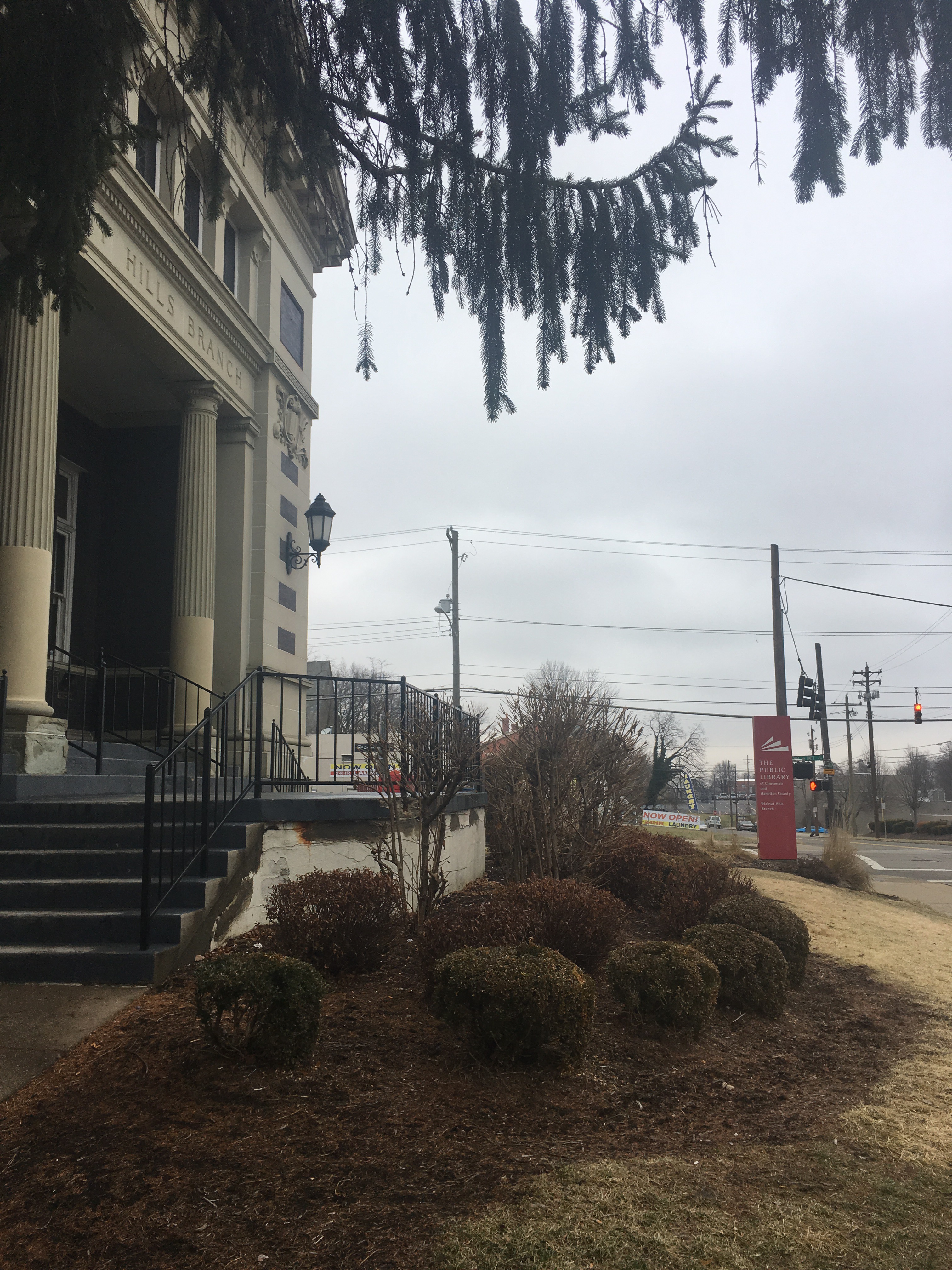
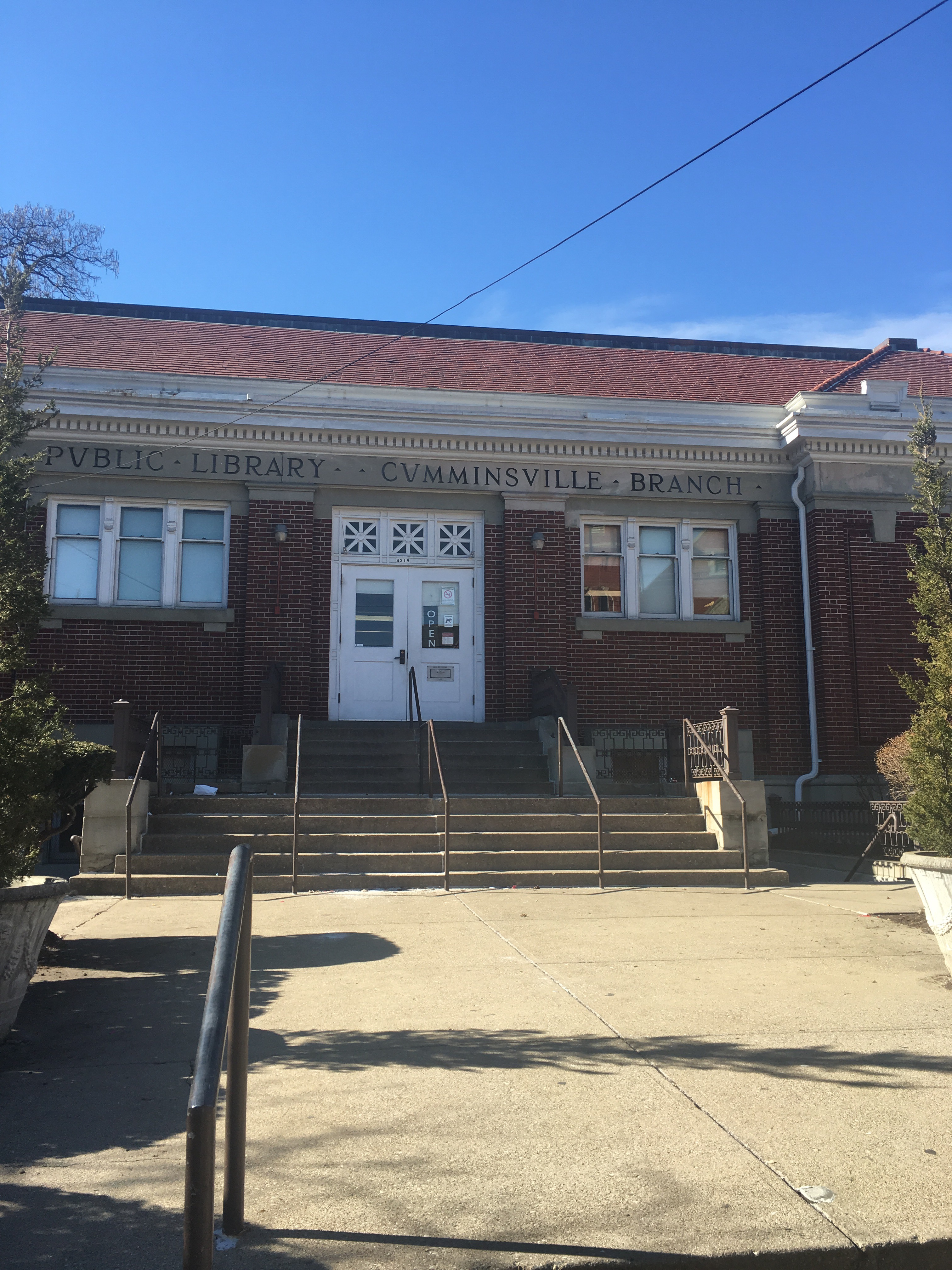
The Northside branch is one of Cincinnati’s Carnegie libraries, and was built at the time when much of the area was better known as Cumminsville (hence the inscription at the top of the branch). 

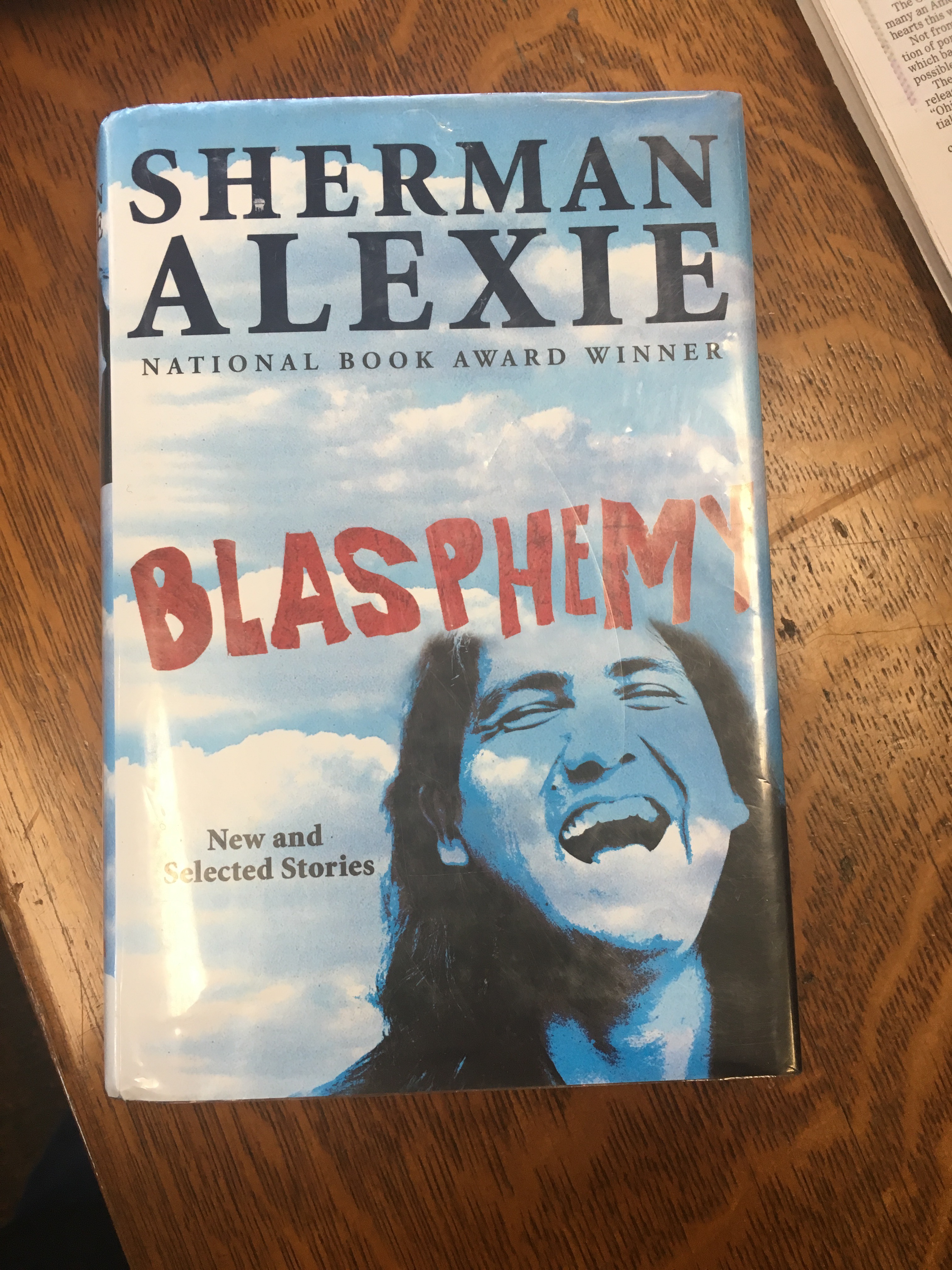
Although I rarely seek them out on purpose, I often like collections of short stories more than I expect, and I’ve never read anything by Sherman Alexie, though he’s been on my authors to read list for a long time. 

College Hill

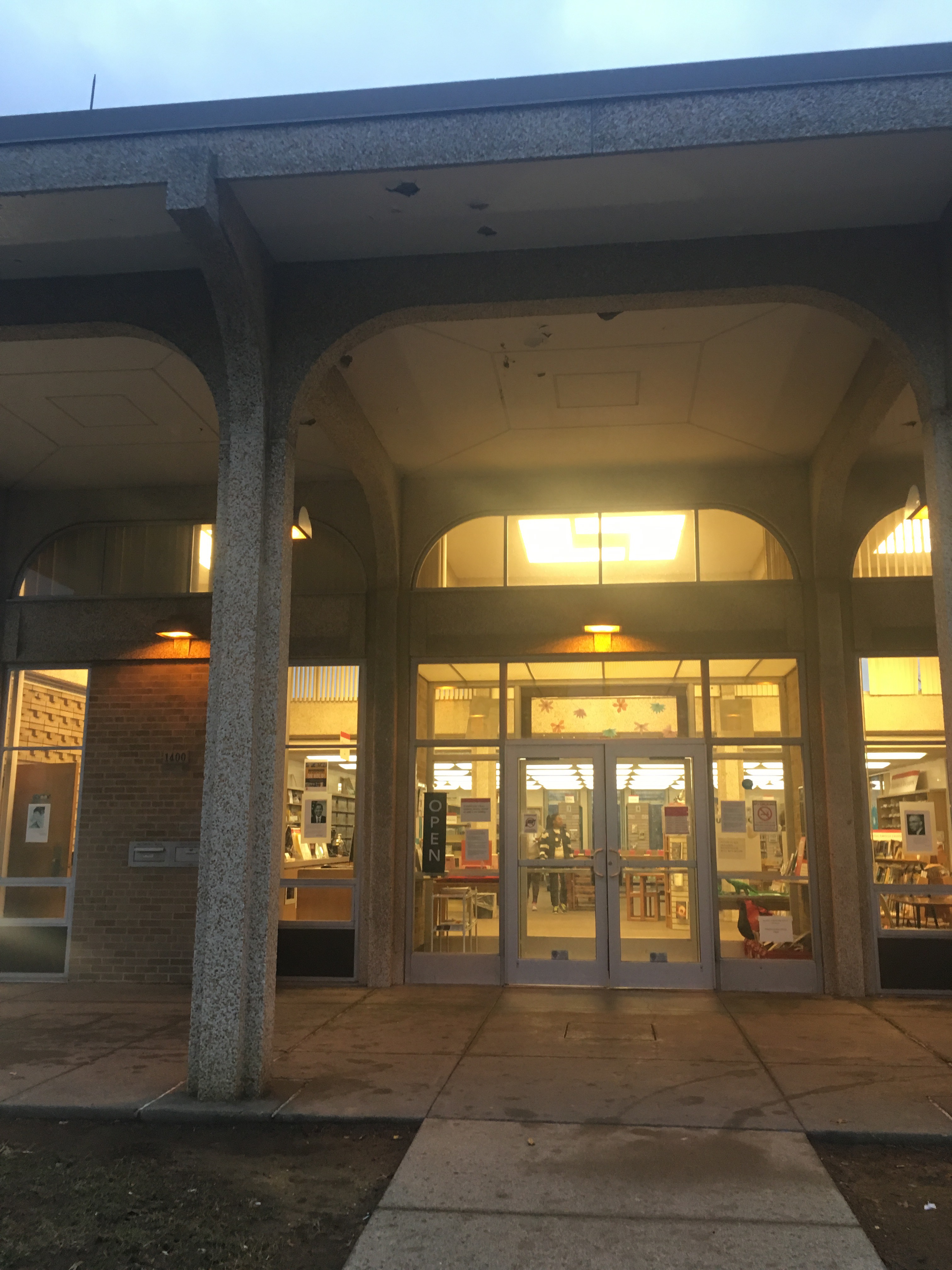
Visit #3: College Hill, January 16, 2017 (Martin Luther King Day)


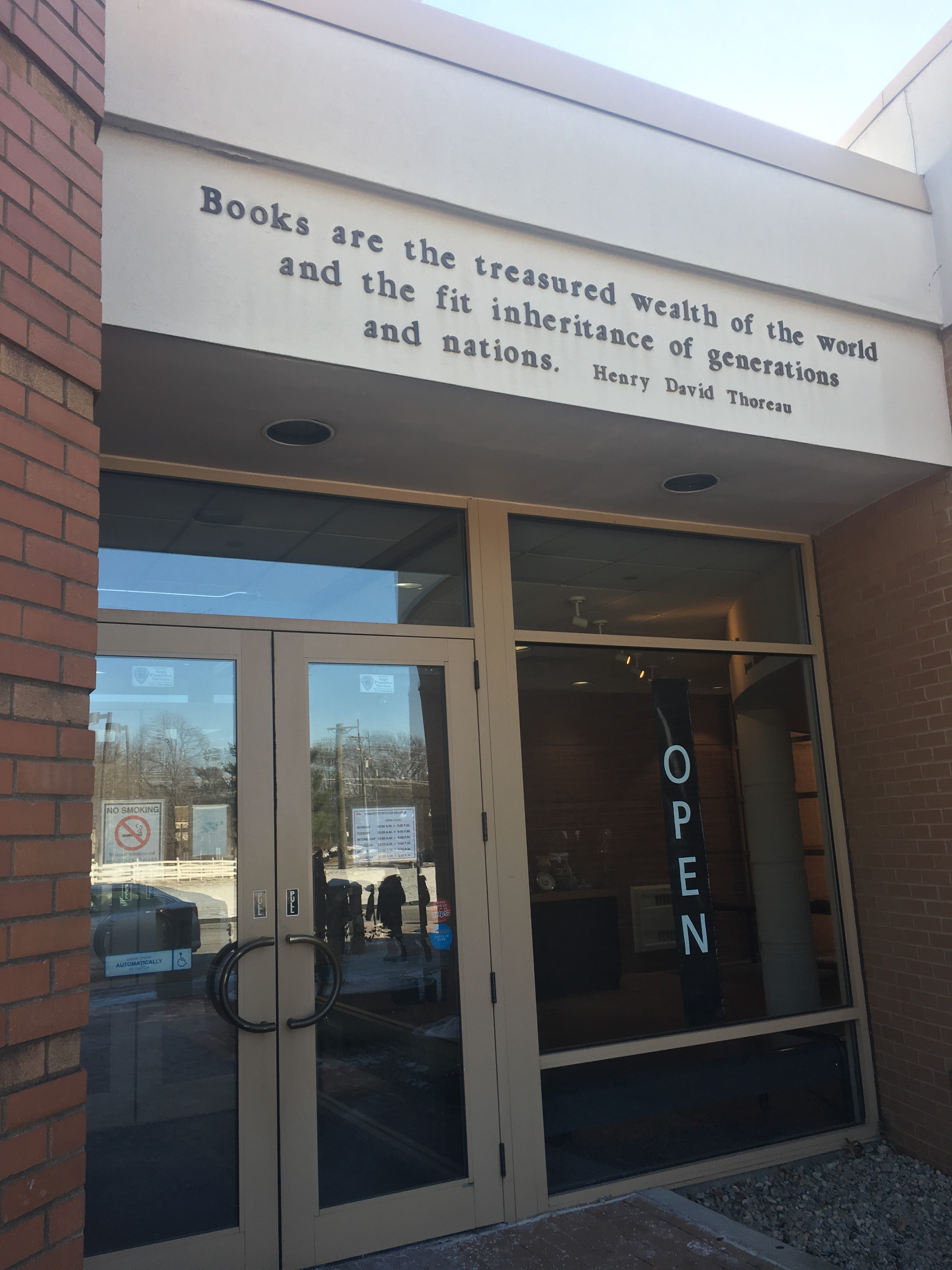
I really liked this branch! They had several inspirational posters hanging in the windows with quotes from prominent black Americans about the importance of reading, libraries, and books. 

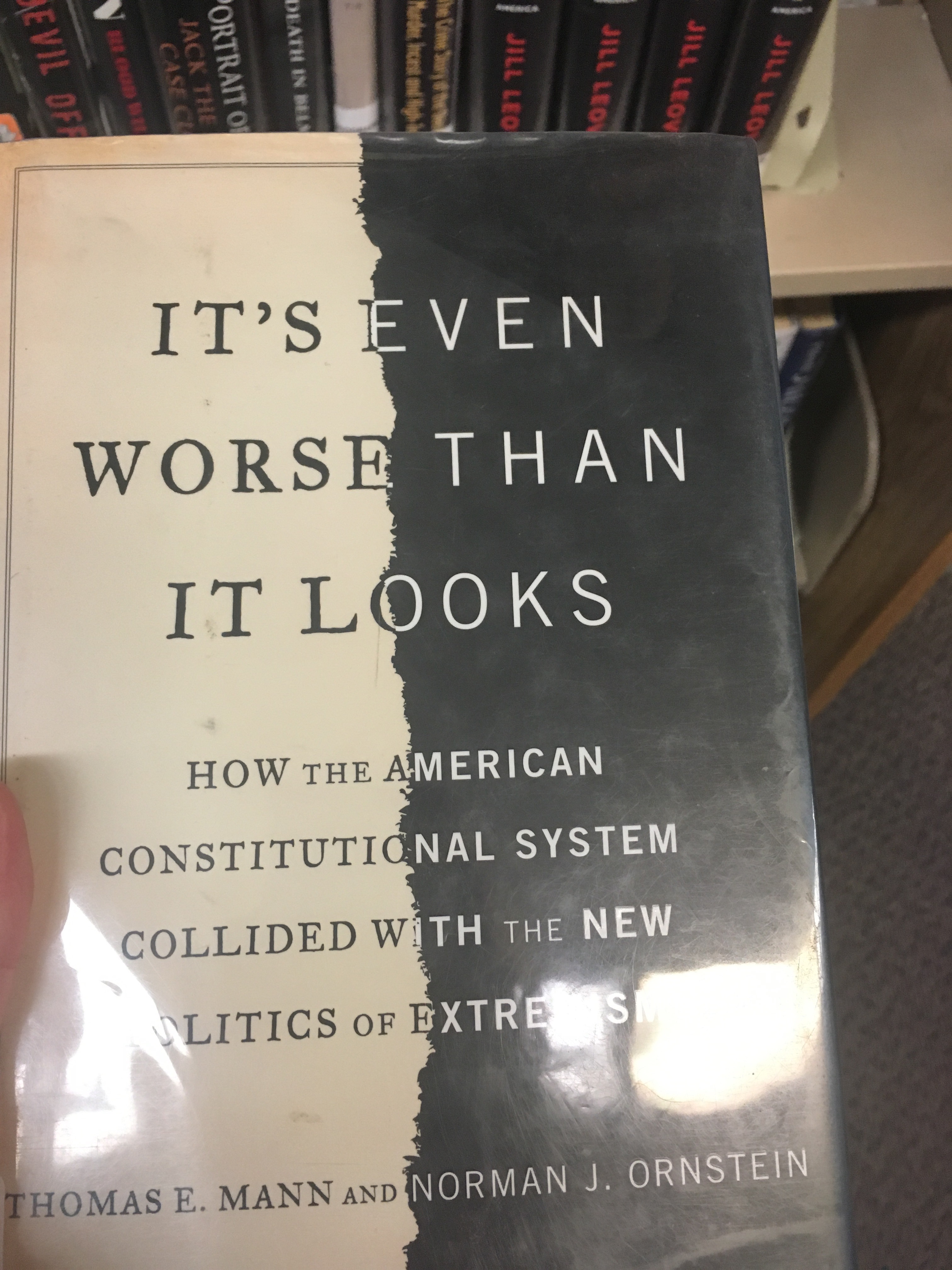
Earlier that day I had attended an event with my Congressman and discussed the importance of the ACA with a staffer. I’m turning to a lot of books lately for lessons on how we got here, what to keep an eye out for, and how to fight for a better world.


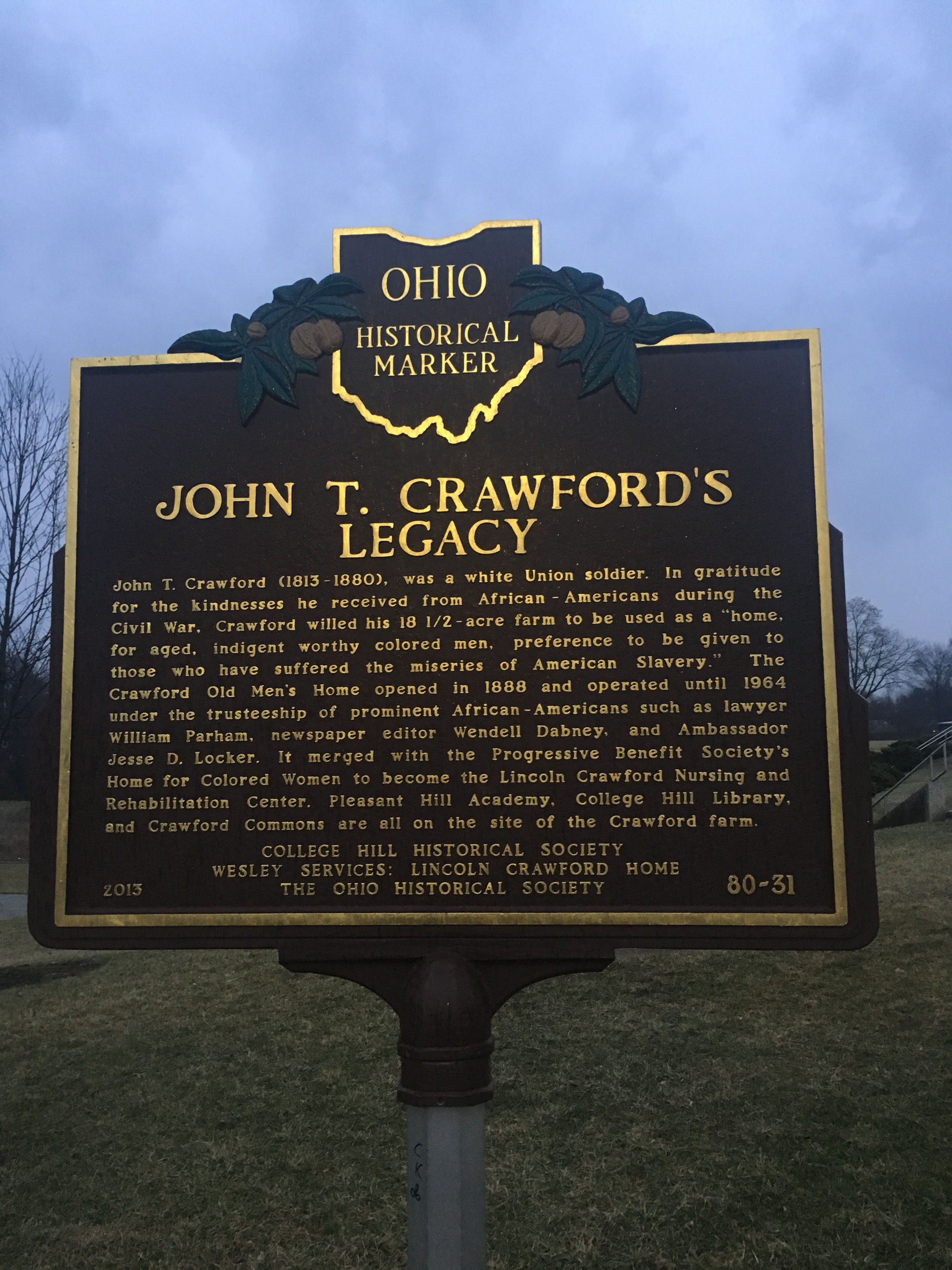
The site of this branch has some interesting local history behind it. 

Citizenship for our sanity and safety, Part 1

During college, I spent a semester abroad in Britain, attending the University of Sheffield, and living in an old house full of students from England and Wales. I was the only American, and it was in 2006, when the Bush administration followed every American abroad with an embarrassing shadow. I will forever be grateful for my time in Sheffield, for the many things I learned inside and outside the classroom. Perhaps one of the most curious things that living for several months in Britain taught me was a new appreciation for America and my American citizenship, something that was often hard to feel in the throes of the Bush administration’s “You’re either with us or against us” calumny that denied the creative imagination that patriotism could be about love for something that can never be tried in a court of law or legislated away. Being the proxy for endless questions about the insanity of the Bush administration during my time abroad helped me discover that my patriotism is a deep and abiding love for the diverse peoples of America, the food of America, the music of America.

I am still in Facebook contact with a handful of my old housemates. When Brexit came down the pike, many of them were devastated, because their work and career plans were dependent on the assumption of continuing close ties with the EU. It was awful and I felt helpless to watch their reactions online. Several months later, it was my turn. I asked a friend of mine who works for the Guardian if he could give any post-Brexit advice for us terrified Americans, and he said he was hoping we wouldn’t screw up our election. Well, fuck.

Last year, two major cases went to the Supreme Court that made me realize how quickly I felt like my rights were being held hostage above a massive federal abyss: the Friedrichs case and the Whole Women’s Health case. This was also happening against the backdrop of the death of Supreme Court justice Antonin Scalia. The former could have potentially gutted public sector unions across the country. The latter would have been yet another blow against abortion rights by legitimizing the shenanigans of the Texas state legislature.

As someone who has been committed to abortion access since I was a teenager, and as a public sector union member, these cases terrified the shit out of me. It felt like my rights were hanging on by the thinnest of threads, and the truth is… they were. They still are. They probably will be for as long as I inhabit my female body and live in a society in which the presence of capitalism is so ever present it becomes invisible. I was able to catch my breath when Friedrichs tied the court, and the Whole Women’s Health case was decisively reversed, but those feelings have always felt like temporary victories rather than long-term assurances, even when I had hope that Clinton would win (for the record, I thought she would win, but if she did, it would be by the slimmest of margins – which I guess is a kinda sorta true, but painfully absurd, version of how it played out).

I have been trying for weeks to write follow-ups to my immediate post-election post, and I have several half-finished drafts waiting in the wings. Indeed, I think it’s safe to say the majority of the US, if not the world, now has their own version of standing at the edge of the abyss, wondering how far and how devastating the drop will be.

The thing that concerns me above everything else about this new administration is I do not, for one second, trust the new President to protect us from threats foreign and domestic. We know at some point a terrible tragedy will take place during Trump’s administration. If it lasts as long as 4 years, we’ll likely have several. It could be something predictable that the United States seems desperately in denial about ever doing anything about, such as a school shooting with a gun that was more easy to obtain than healthcare, or a devastating hurricane that breaches infrastructure we have deferred maintenance on for far too long because billionaires have more right to shelter their income than pay their fair share to public works. Or the tragedy may take the form of something that will be used as an excuse to erode our civil liberties even further under the guise of protection. We only have to look at the many ways the language of patriotism was coopted by the Bush administration in the wake of 9/11 to justify erosion of American civil liberties.

Even in the total absence of any tragedies, we know going forward over the next 4 years that the onslaught on the rights and liberties of those who call America home will be relentless. Before inauguration day, the GOP signaled that they will not take seriously the safety and security of the American people, by setting the stage to repeal the ACA before an adequate replacement has been shown to the public, and by supporting the nomination of a man who is grossly unfamiliar with the dangers of lead contamination. These are just two examples of dozens, but let’s be clear: these examples alone have the potential to gravely affect the health and mortality of millions of American women, men, and children.

Perhaps the most noxious preview we received of how little the new administration gives a shit about basic safety was the under-discussed example of Trump whining about fire code requirements and disgracefully calling into question the competence of fire safety officials that restricted attendance at his rallies because of safety codes. Building safety code requirements only exist because of tragedies in which far too many people have died needless deaths. At the time, many people laughed about Trump just whining because that’s what he does, right? For me, knowing my Cincinnati-area history of local fire and crowd control tragedies, it sent a chill down my spine. That Trump would compromise even the safety of his own supporters during a rally says everything about his regard for the safety and security of the rest of the American public he is now charged to protect.

Tons of people since 11/8 have written numerous guides about how to fight back, how to resist, how to continue fighting against the enormous odds. These are good resources, and I recommend that every patriotic American take inspiration and more importantly, action from these resources. I will continue to do all of these things as well. I also want us to be real: no adults are left in the building who are coming to save us. The Democratic party will not save us, Silicon Valley won’t save us, universities won’t save us. If we’re lucky, local and state governments will do what they can, but even this remains to be seen. We have to rely on ourselves to be patriotic citizens that protect each other from whatever comes that almost no elected leaders or public figures have shown the courage to do so far.

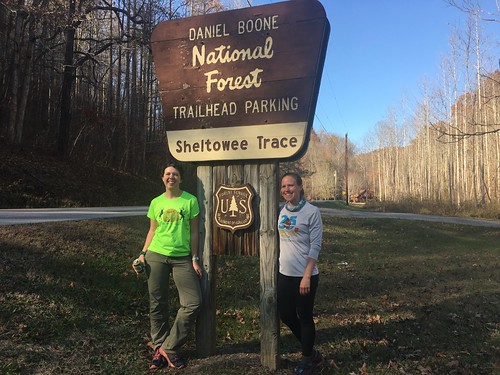
What I Learned From my Sheltowee Trace Section-Hike

So I now have my Sheltowee Trace section hike behind me, and in fact, the Class of 2017 is starting out on their first hikes. I’m so glad I committed to hiking the entire trail, because it taught me a lot about how to be an effective hiker, and it fostered a deep and abiding love for my neighbors on the south side of the Ohio River.

The Gathering is the end of year celebration when the new class is inducted, news about the future of the Sheltowee Trace Association is shared, and people celebrate the many friends of the STA who contributed to the progress of the trail over the last year. We all shared much delicious food together at the celebration. I have to figure out how to use these wonderful patches:

To summarize my experience, I want to share a list of 10 tips and takeaways for new hikers (whether you’re embarking on the Sheltowee Trace Class of 2017, or just resolving to hit the trail more in general):

  1. Start maintaining a gear spreadsheet for every overnight hike you take. Check things off as you load them into your pack. I created one that had my entire gear list for each month. Then by the time the November hike came around, I was able to simply reuse the sheet from January and tweak it with some new changes. If you have a kitchen scale, you can use it to weigh your gear and make smart choices about where to shave off ounces.
  2. New hikers tend to stop a lot because of organization issues. As you hike more, you’ll get better at realizing what you need to have close at hand or how to dress so you don’t take off your pack every nine minutes. For me, this meant taking off a layer right before I hit the trail (but storing it someplace accessible for when I took a break), and ensuring my hip pocket had at least two snacks so I could hike for at least 60-90 minutes without stopping.
  3. My best and nerdiest navigation technology hack I came up with during the year was to take a picture of my paper map and then store it on my iPhone lock screen. That way I didn’t have to dig out and unfold my map all the time.
  4. Washi tape is the best way to mark up your maps. I use it to mark three X’s on my paper maps – the beginning point, the campsite point, and the ending point. This would help me quickly find where I was and how much I had left to go.
  5. I get very freaked out by hiking in the dark unless the trail is very obvious and I’m with a big group of friends. I learned the hard way that when you’re hiking in the foothills, the time given for sunset isn’t necessarily the actual time it gets dark. If you’re hiking in a valley, it might get dark enough to significantly reduce visibility long before actual sunset. Always make sure your head lamp is easily accessible and has extra batteries just in case!
  6. Remember that not only may you not have cell service on the trail, you might not even have it on the last several miles on the drive to the trailhead. Download any offline maps or send any texts by the time you exit off a major highway just to be on the safe side.
  7. Going stoveless in the summer is amazing. You should give it a shot at least once. “But coffee!!!” I hear you caffeine fiends screaming. Starbucks Via Iced Coffee packets work just fine if you dump it in a bottle of water and shake. I was able to hit the trail so much earlier in the summer because I’d pack up my gear, and then eat breakfast while hiking the first couple miles on the trail (iced coffee sipped from my bottle and nibble on a clif bar).
  8. I was rarely did it consistently, but yoga or deep stretching before you go to sleep really helps with sore muscles the next day. Along with popping an Aleve right after dinner.
  9. Hike your own hike. As long as you aren’t endangering yourself or others, and try to practice Leave No Trace as much as possible (there’s rarely a good excuse to cut switchbacks!), there is no right or wrong way to hike.
  10. People often think of hiking as a hobby, but the truth is the skills it gives you are so much greater than what you can use just out in the woods. I am now a better suitcase packer because of so many hours learning how to organize my pack. Recently, I was in Las Vegas and while walking through a casino, some creepy guy tried to grab my wrist to talk to me. I whirled around and shouted NO! in an assertive “don’t f–k with me” kinda voice and walked away. After a few minutes, I realized this is the exact same way I reacted to dogs who snarled at me while I was hiking on country roads. And finally, the trail teaches you what you don’t know, which is a humbling experience. This year I began to realize how little I know about forests and tree identification, or geology, or how land protection decisions are made. It’s good to be reminded that there’s always more to learn.

In addition to ensuring you have the classic 10 essentials, these are my 10 personal favorite gear essentials:

  1. GaiaGPS app: For paid apps, it’s a bit expensive but worth the cost. On every hike I take, I start recording my hike with the first step I take. That way, if I get lost, I can retrace my steps to where I last had my bearings. GaiaGPS works in airplane mode, which is also great – though if possible, you should take it out of airplane mode whenever you begin recording a new hike, in order to enable map loading. Once you’ve started a few minutes in, you can set it back to airplane mode. I saved all my tracks and downloaded them later from the website – this is how I was able to add tracks to all my Sheltowee Trace trip reports.
  2. Battery charger: A bit heavy, but worth the peace of mind. This one gives somewhere between 3-4 full recharges for an iPhone. On the downside, it takes forever to juice up the actual charger itself – so you may want to take care of that a couple days before your hike, rather than assuming you can charge it on the ride to the trail head.
  3. Hiking skirt: I love hiking in a skirt. It’s amazing! I like Purple Rain hiking skirts because it’s a woman-owned business and the pockets on her skirts are actually functional. And I don’t know how this is possible, but somehow this skirt never twists around but always stays right in place. When you hike in a skirt, you don’t get swamp butt, you can move much more freely, IT’S SO LIBERATING. I hiked in my hiking skirt from late spring to early fall (and while some would probably shudder about skirts during tick season, most of the ticks I ever found on me somehow climbed down through my socks. Everyone has to do their own risk assessment). Disclaimer: if you’re on a trail with a lot of thorny brush or massive trees to climb over, you might want to don some pants instead.
  4. RoadID: I often day hike alone, or even during the group Sheltowee Trace section hikes, would often go a couple hours at a time hiking on my own. If I ever get injured or pass out, I want anyone who finds me to know how to contact my loved ones. I don’t set foot on the trail, even if it’s a park near my house I know well, without this on.
  5. Polarized lightweight sunglasses: With all the road walking on the Trace, it’s important to have a good pair of shades when you exit the forest. I like these – they are lightweight, if it’s windy out dust won’t blow past the frames into your eyes, and they cut down on glare.
  6. Trekking poles: I can’t find a link to the exact kind I have, but I use a set of Leki trekking poles. They are lightweight but also quite strong. I am by nature a klutzy person, so besides all the usual reasons to use trekking poles (weight distribution, less stress on knees, etc), they have prevented me from sustaining a major injury more times than I can count.
  7. Bandannas: Besides ziploc bags, bandannas are the one thing any hiker can never have enough of. You can use them as a napkin, as a sweatband, as a pee rag, as a washcloth, as a temporary bandage if you cut yourself, etc etc. I bought a giant multi-color variety pack a few years ago, and usually bring a few on each hike with me.
  8. Gaiters: Gaiters are pretty far up there (maybe just under various models of sun hats) of dorky hiking gear that are totally worth looking like a dweeb. Gaiters are critical in early spring when it seems like everything is chilly and wet and muddy. In the cold months when I wear pants I use LL Bean gaiters. I didn’t use them in summer when I switched over to trail runners,  but my friend Susanna just gifted me a pair of Dirty Girl gaiters that I look forward to trying out for warm months to prevent sand and dirt from collecting in my soles.
  9. Alcohol stove: You can’t use alcohol stoves everywhere in the US, and even in areas you can use them, be smart about using them safely. That said, you just can’t beat them for weight, especially if all you’re doing is heating up water. I really like this one (though I need to get a new one after accidentally setting the rubber gasket on fire – entirely due to user error. Remember what I said about using them safely?) Sometimes finding a good container for the alcohol can be tricky – I like using an old trial-size bottle of Listerine (a tip I learned my first month out on the trail when I saw someone else doing it!)
  10. Collapsible flask: I’ve never regretted the weight of packing a flask, but then I carry this super-light one. If you can find a trail angel to bring you some Ale8, pour a little bourbon in that and you have the best damn post-hike cocktail in the state of Kentucky.


Symmes Township

Visit #2: Symmes Township, January 7, 2017


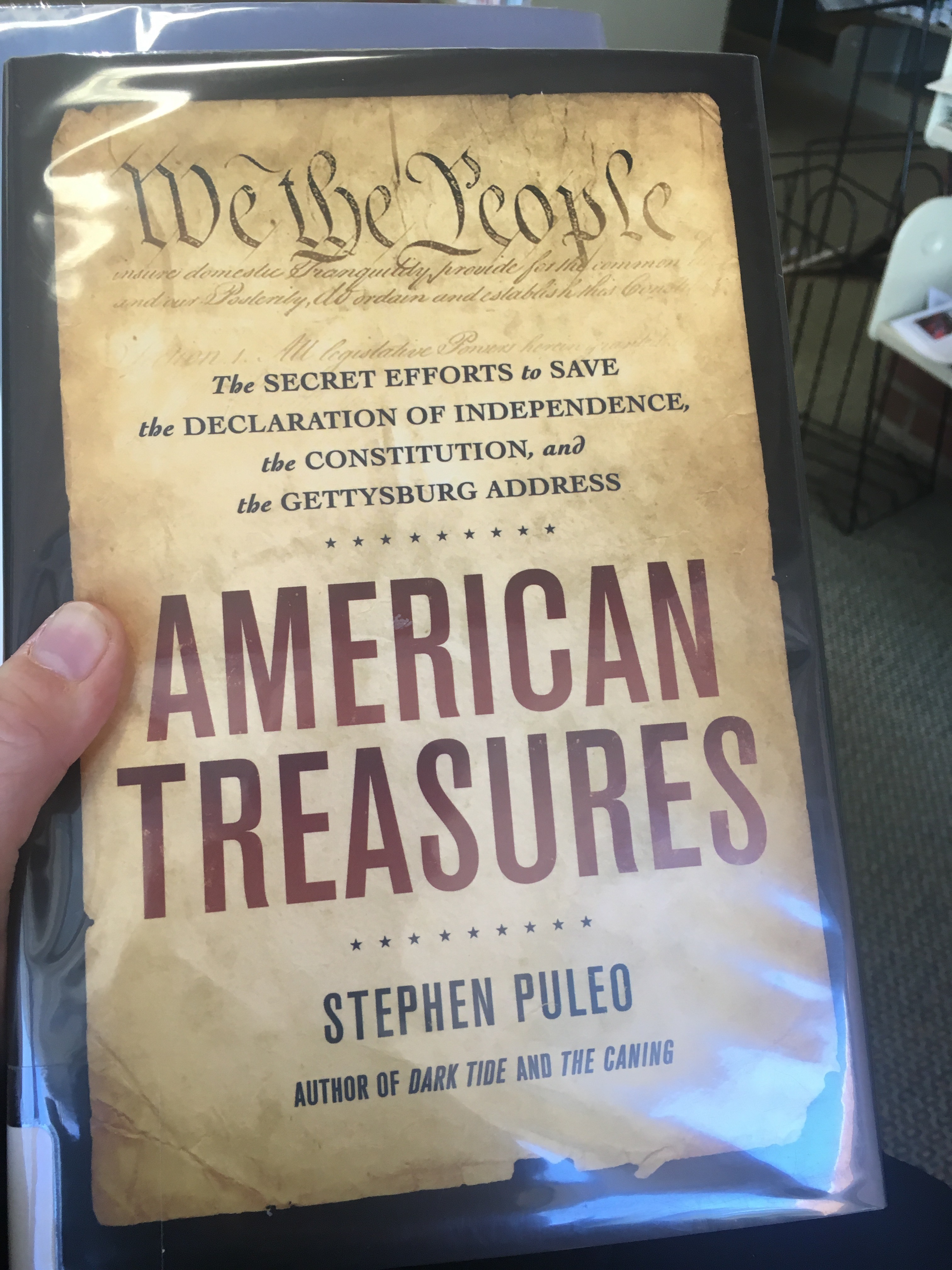
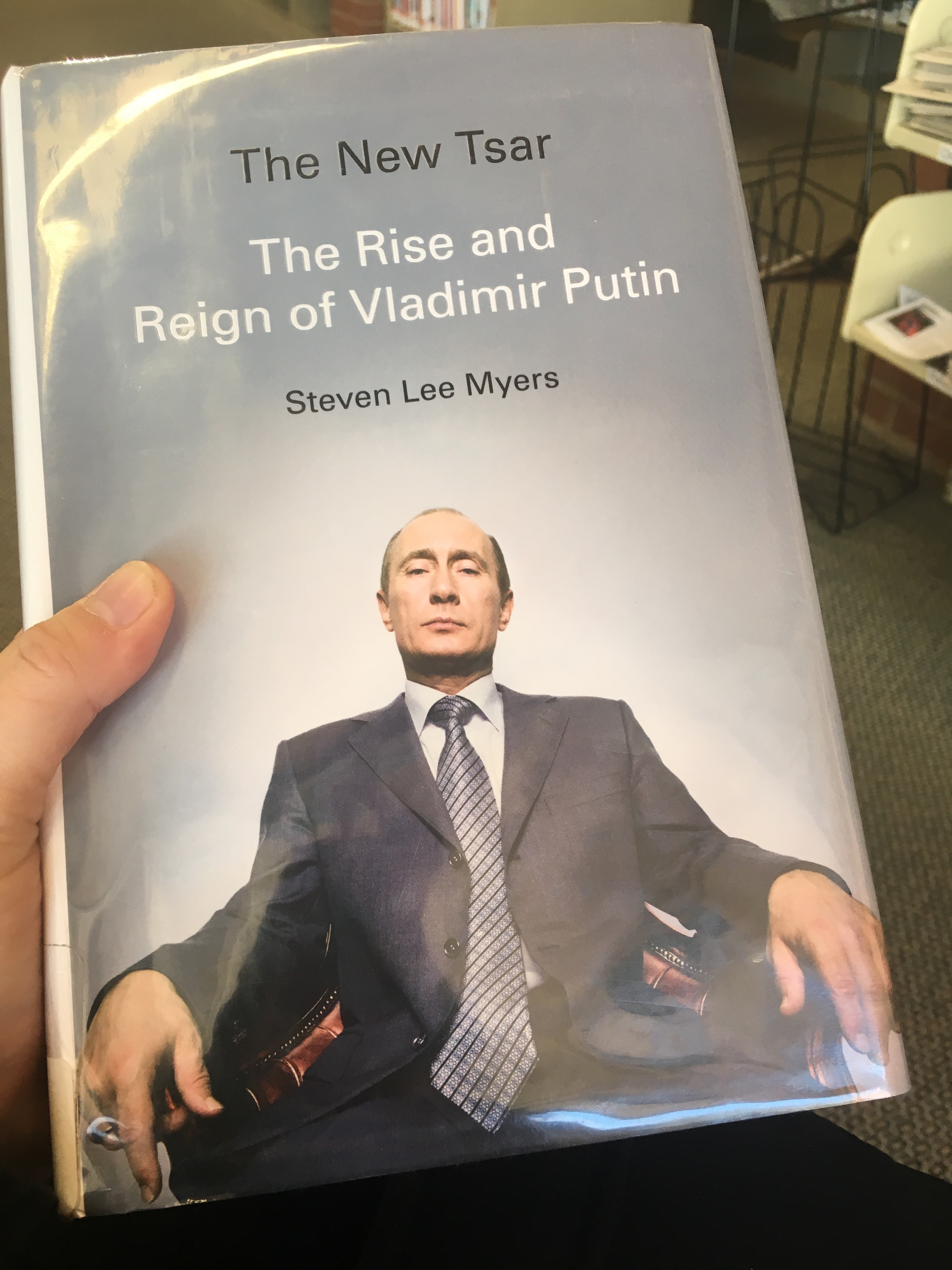
This book had a quote from David Ferriero, the Archivist of the United States on the back, so of course I had to get it.


And then, uh, feeling like I need to learn more about this dude. Is this combination a little too on the nose? 

Walnut Hills

Visit #1: Walnut Hills, January 2, 2017


This is my neighborhood branch library, and it also happens to be the first Carnegie library built in Cincinnati. 

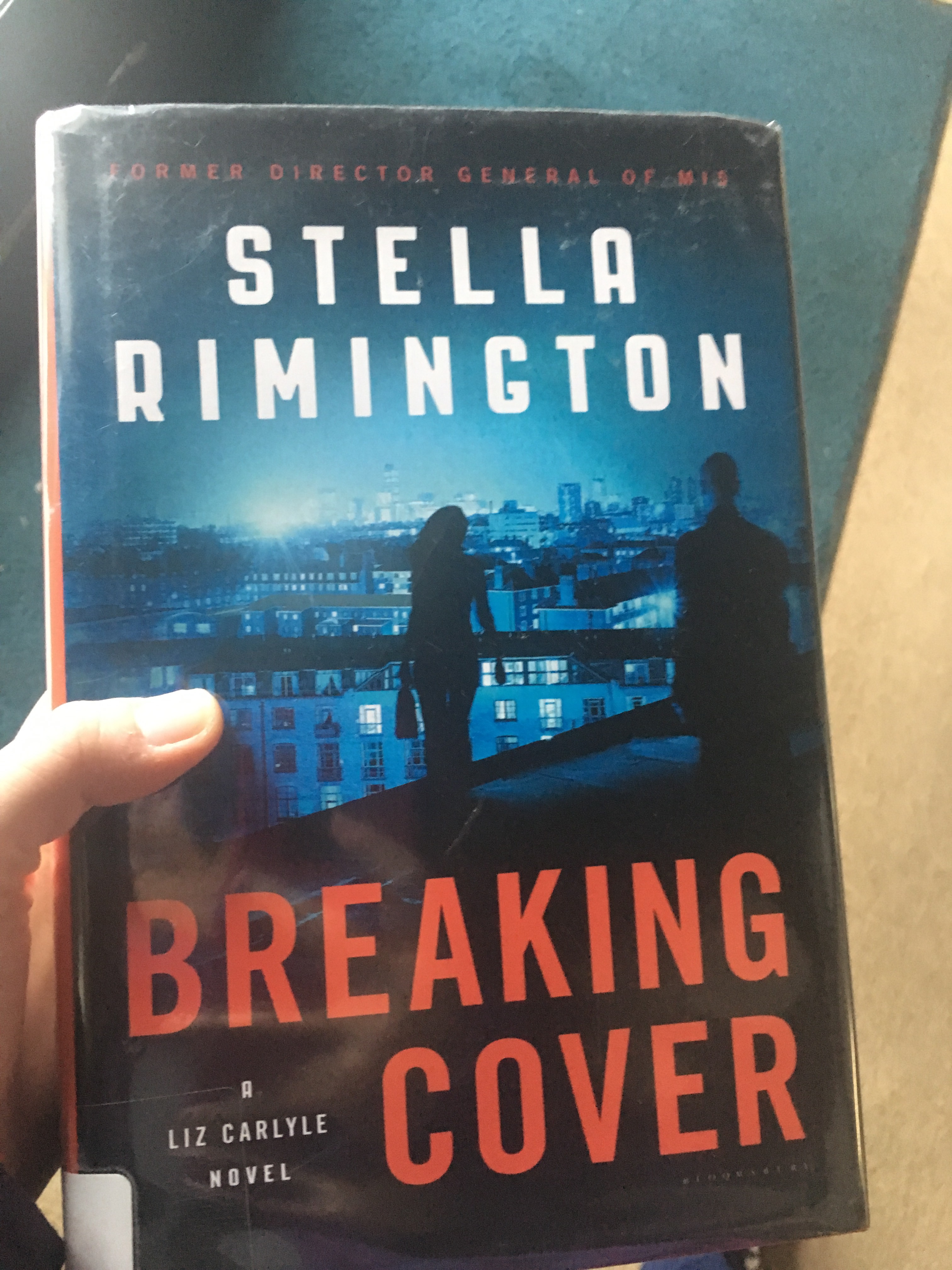
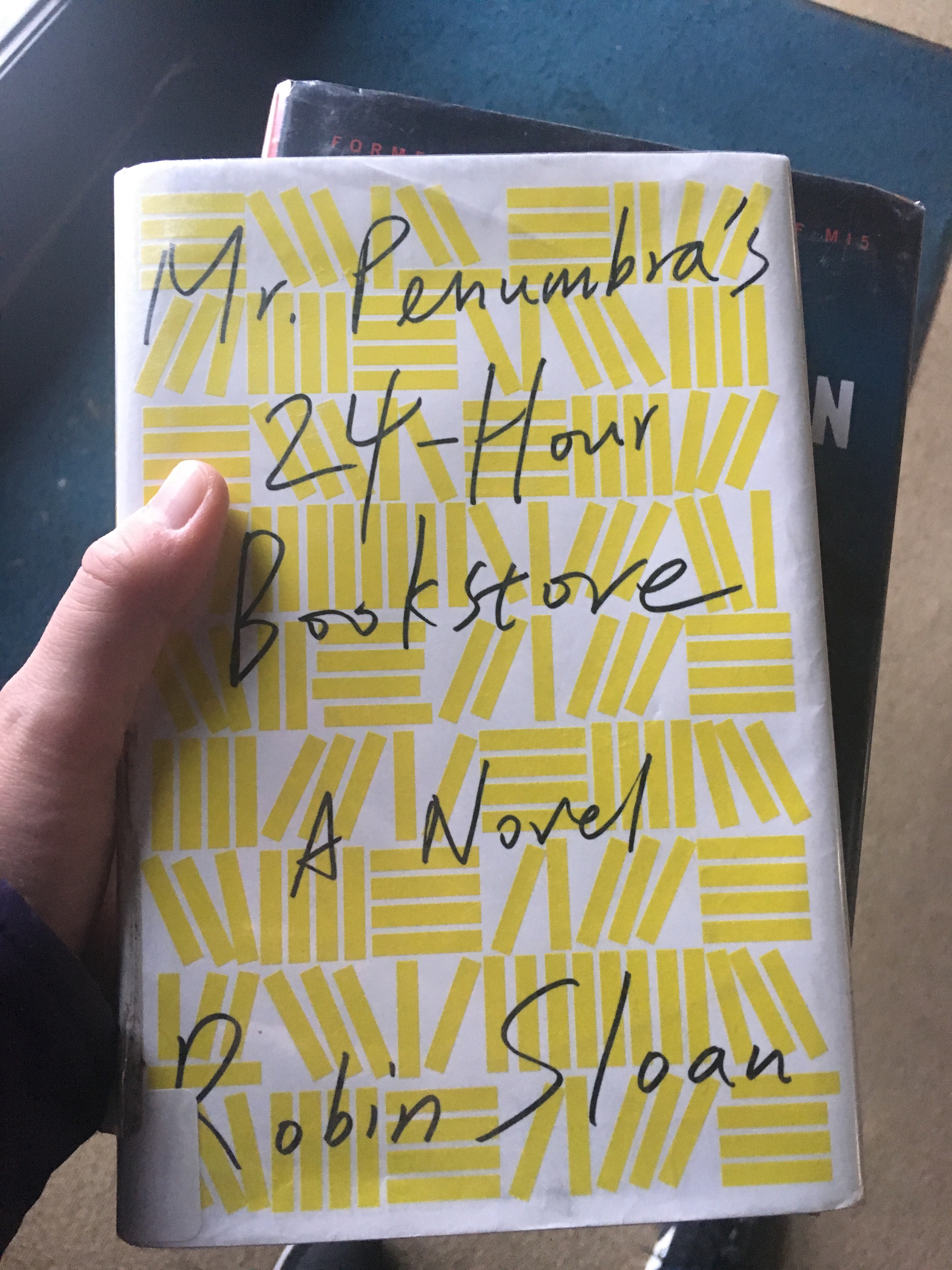
Both of these books passed the first page test (is it interesting enough that I want to keep reading past page one?) The Stella Rimington book is also a nod to a past project where I watched all the James Bond movies (context for Rimington’s connection here). 


Visiting every Public Library of Cincinnati and Hamilton County

I am a huge fan of projects that last a year. This year I plan to visit every location of the Public Library of Cincinnati and Hamilton County (PLCH). There are 41 locations, including the main library downtown.

We are fantastically lucky to have such a wonderful library system. I think a large part of what led me to my career as an archivist was growing up in an area with an extensive library system. I loved hanging out at the library, and it’s pretty cool that now I get paid to work at a library!

Cincinnati really does rank among having one of the best library systems in the country. This has deep historical roots, and can be dated back to strong state support for county library systems, as well as the success of the early PLCH trustees in getting Andrew Carnegie to fund many of Cincinnati’s earliest library branches. Full disclosure: I wrote my undergraduate capstone (like a thesis) on Cincinnati’s Carnegie libraries, and recently published an article in Ohio Valley History on the topic. You can read it here if you have journal access, or view an open-access pre-print here.

I’m one of those rare Cincinnatians who has lived on both the west and east sides of the city, so I’ve always explored the branches near wherever I’ve lived. And as part of my research on Cincinnati’s Carnegies, I’ve visited all of the Carnegie-funded branches. But this still leaves many branches I’ve never set foot in.

2016 was a really difficult year for almost everyone I know, including myself. At the beginning of 2017, I’m spending a lot of time thinking about what a meaningful life looks like. For me, this includes one that is deeply connected to my local community, and full of intellectual growth and critical thinking. Obsessively following the 2016 election meant that I was often glued to “horror scrolling” (credit to my friend Avril for that term) through the news from the glow of my iPhone rather than spending time with a good book. I don’t think staying on top of the news is mutually exclusive with having a robust reading life (and indeed one of my favorite genres includes non-fiction written by journalists, like Isabel Wilkerson’s The Warmth of Other Suns) – but it’s clear that over the last year the balance was really out of whack for me.

So since I want to read more, and want to feel even more connected to my hometown, what better way than to visit every PLCH location over the course of 2017? I also plan to check out a book from every branch. While I’m not sure that means I’ll actually read 41 books this year, if I even double this year’s count I’ll be happy. I’ll post a couple pictures from every visit – a shot of the outside, and a picture of whatever book I check out from the library. I do enough writing for my actual job, so don’t expect lots of commentary… but if I learn a fun new fact or two from my visits, I’ll be sure to share them.

Swing State Voter Report: Some warmed-over hot takes

In recent days, there have been a spate of broadcasts and articles on “here is what historical precedent/constitutional law/the Magic-8 ball on my desk tells us about what to expect from a Trump presidency.” I understand this, and for a minute I was consuming this media as desperately as I refreshed 538 through the campaign. But the problem is we are in truly uncharted territory, where the historical past can only tell us so much about what to expect from the future.

I spend a lot of my time thinking about how we can learn from the Earth, and in particular, what Americans can learn from our relationship with the American landscape. And I had a pretty epic realization the other day, the kind that immediately made me look for the beer with the highest ABV in the fridge: Donald Trump is a lot like climate change itself. Historical data only gives us a baseline to measure how radical things are getting, but it can no longer provide us accurate predictions of the future because what has taken place is so unprecedented. This is why flood insurance maps/flood predictions get so politicized – they are based on historical flooding data, but historical data is no longer predictive of a world with a 2C temperature increase. But regardless of how unthinkable and terrible Trump and climate change is, this is really happening, and as things get underway, it seems to have a scary effect of accelerating things faster than we thought. We can predict things will be bad, but the timing of when shit will hit the fan and how bad it will be, or if we’ll only actually realize it hit the fan in retrospect, is part of what makes all of this so gut-wrenching.

I have a lot of thoughts about the many directions of fallout from this election. I don’t think I’m going to do a good job of unpacking all of them in one go, but here are my hot takes on everyone else’s hot takes, and I won’t even make you pay a subscription for my blog (but I always welcome a beer next time you see me if you like what I write).

First, a quick word on hot takes in general: A diagnosis is not a cure. A diagnosis is not a cure. A DIAGNOSIS IS NOT A CURE. Right now, I’m seeing too many postmortems and not enough “…and here’s how we win elections again and fight like hell in the mean time.”  I don’t know about y’all, but nihilism is not a solution (and it sure as hell ain’t a cure). In fact, I strongly believe nihilism is one of the most weaponized forms of oppression that people internalize far too much. Fuck nihilism, do whatever you need to do to be rested and ready for the road ahead. I’ll be back with more writing in the coming weeks.

Back to the title of this post:

How I’m Handling Existence At The Moment:

I don’t think it’s an accident that the vast majority of people who were checking in on me within the first couple of days after the election were women. Women know how to do emotional labor, and lord did the women in my life deliver it over and over as soon as it became clear what was going on. It really sucked to go from feeling like I was serving democracy by working the polls on Election Day (I definitely now feel entitled to my strong opinions about how elections are administered), to taking the express rocket into the post-election hell mouth. For the first 36 hours or so after the results I was dealing with physical symptoms of something (panic? shock? not totally sure but my blood literally felt cold and I felt like the skin on the back of my arms was going to peel off). I also had to drive up to Pittsburgh the morning after the election for a conference, and mostly made it there safely thanks to distracting podcasts and a long phone call with my best friend.

For friends and colleagues who reached out to me: thank you, thank you, thank you.

Why are we obsessed about the white working class and not the white McMansion suburbanites?

Ask yourself why coastal media outlets are so obsessed with profiling the poor white people who voted for Trump and not the similar numbers of middle- and upper-class white people who did the same. I have some theories, they involve two things: 1. White people acting like a six-figure salary and a college-degree makes them immune from racism and related dubious-political choices, 2. These same media outlets don’t want to piss off their subscriber base.

A word for those who want this election to be permission to write off the Midwest and South forever: you’re telling me that women, people of color, and LGBTQ folks who live in the middle of the country don’t matter.

You want some progress from flyover country? Send the folks in the South and the Midwest who are DOING. THE. DAMN. WORK. some help, money, or prayers, or STFU. I really, really, really need the national Democratic party leadership to not abandon the Midwest right now, because my reproductive rights will literally depend on it the second Roe is overturned at the federal level and bullshit trigger laws start taking effect. I don’t want to have to get on an airplane if I ever need an abortion (something that is already a reality for a lot of women in this country).

Do you know how hard people in places like Texas and Ohio work on things like reproductive access? Harder than you can possibly imagine. We work our tails off because it’s not abstract, it’s not theoretical, it’s very, very real. I’ve been a part of a supporters’ group affiliated with Planned Parenthood for a couple of years now, and people who do not spend time in this area have not a damn clue how bad things already have been for years now.

I don’t need condescension right now from Midwest ex-pats who live in coastal areas that say things like “Ugh, I’m so glad I don’t live there anymore.” I don’t need people to engage in narratives that erase the diversity of the Midwest by trying to say we’re all homogeneous and parochial white people. I REALLY don’t need bullshit secession fantasies

For those of us fighting the good fight right here at home, we need your money, we need your organizing strategies, and if you’ve ever thought about moving, or boomeranging back, to the Midwest, I can’t think of a better time to come here and help us. We need all the help we can get. And assuming we don’t all perish first in nuclear war, you know you’re going to want to be in a state that has access to some of the best freshwater sources on Earth when climate change really fucks things up.

Where are the geographers? 

I really need some good, county-by-county breakdown on WTF happened in Midwestern counties that went Obama-Obama-Trump by the political geographers out there. I’ve read probably a dozen theories by now, but much of it is highly speculative (as well as lazy, uncritical, and self-serving), and there has been precious little comparison of in-migration/out-migration demographics (i.e., did the eligible voter population change in the last 4 years in a way that favored Trump), how voter restrictions might have affected the populations in those particular areas, how gerrymandered legislative districts might have affected turnout for the national ticket, etc etc.

Because I haven’t seen any articles from anyone who seems to know what the hell they’re talking about when it comes to Ohio political geographic analysis, I went and looked at the counties that Democrats have carried in the last several elections (2000, 2004, 2008, 2012, 2016, disclaimer: I have not verified wikipedia’s sourcing of county return data against official state elections sources). While this is very quick and dirty, non-scientific, non-rigorous analysis, here is what I found. Basically from 2000-2012, Dems consistently carried an average of 17 counties per general election – in other words, most of these were reliable Democratic counties that we won despite whether it was Bush or Obama who won the White House. This year? We only got 7 counties (out of 88). I wish a political geographer would dig into this, but this is why I am losing my goddamn mind lately about the state of the state party.

We have been asking too many “why” questions during this election. In my opinion, going forward, we need to be asking more questions that start with “where.” The where matters, because as we all learned the hard way, a national election is not won by “how many votes did someone get?”, it’s won by “where are the states that deliver us 270 electoral votes.” I think the electoral college is horse shit as much as the next lefty, but until that changes, we need a geographic analysis for every single aspect of our organizing. We need to start asking questions like, “where are the counties that we can flip back from Trump? where are the precincts that suffered the most disenfranchisement, and how do we prioritize those precincts for voter registration the next election? where are the most brazenly gerrymandered districts? where are the union halls that we need to make sure the candidate actually shows up to visit if they give a damn about winning labor’s vote?”

The GOP has been building their party up for 40 years and we were asleep at the wheel

We have so much ground to make up because of breathtakingly incompetent leadership who walked away from the 50 State Strategy to concentrate on easy wins or galas or whatever else makes the Democratic leadership confuse schmoozing donors for actual organizing. Meanwhile, not only was the GOP doubling down on the Gospel of the 1%, they rarely left a contest uncontested, turned gerrymandering up to 11 following the 2008 election, all while marinating in decades worth of propaganda from Lee Atwater to Jerry Falwell to Karl Rove.

Maybe the Democrats haven’t completely lost their moral compass, but I sure as hell wish we’d figured out how to win more races in the meantime. Because right now the GOP has an unbelievable lock on both state and federal governance.

Right here in Ohio, we have a habit of throwing promising leaders, who are often young, under the bus. We did it a few years ago. Then the Party came back for more humble pie  this year, outdoing itself by cutting down P.G. Sittenfeld in order to back a candidate who had a compelling millennial outreach strategy that involved telling his younger opponent that politics isn’t like playing Little League. Meanwhile, the “it’s their turn” establishment Democrats get their asses kicked at election-time, and people freak out about who the next generation of leaders will be. Sound familiar?

No matter where they are in life, people feel like their vote doesn’t matter and that’s a problem

Look, I tried to warn y’all about this idea that voting is an individual act of conscience, and how dangerous this ideology is, especially when it comes to turning out the vote. And what’s happened is because we keep acting like voting is this individual declaration of intent or some personal branding signal, then of course when you’re on the losing side, it’s going to feel like your vote didn’t matter.

Some of you may know that I did some voter registration and canvassing for Clinton in the area near where I live. I also served as a poll worker on election day. The areas I canvassed for the Clinton campaign were mostly low-income neighborhoods, and the residents are predominantly people of color. One day when I was doing voter registration, a young black man told me he doesn’t vote because he doesn’t believe it matters. The area where I served as a poll worker was in an area that was middle to upper-class, with predominantly white residents. During my very long day checking people in to the voter registration book and issuing ballots, some older white people also grumbled and said “None of this matters anyway, our votes won’t count.”So folks, this is where we’re at: no matter where they’re at in life, tons of people in my own corner of Ohio feel like their vote doesn’t matter. This is true across the country.  How do we get people to recognize that their vote does matter, at least in the herd immunity position I’ve argued from? Do we highlight stories where razor-thin margins show just how much one’s vote counts? We have these stories in abundance from local and state elections. Again, I feel like the focus on the top of the ticket has really hurt politics overall – of course in a national election, your vote has less “weight” simply because of volume. On the other hand, local elections mean your vote has much greater weight.

When my husband and I were encountering friends during this election season who simply couldn’t be convinced to turn out for Clinton, we at least implored them to still show up to vote, and vote for the down-ballot tickets. But this is never a message that official get out the vote machinery will say – it starts with “Vote for (Presidential Candidate) and oh, also, by the way, for these down ballot issues and candidates”. I suspect people’s brains click off after they decide “well I’m not voting for the President, so why bother showing up at all?” This would have to be confirmed by comparing overall turnout numbers with how many people voted a blank race at the top of the ticket. I hope someone does it.

Either way: even though this election has global implications that I fear will reverberate for decades, nothing has brought home for me how much local politics matters than this one. And that’s where I plan to put an enormous amount of my work in over the coming years.

Sheltowee Trace: Section 11 – Morehead to the Northern Terminus

Dates: November 12-13, 2016
Weather: Cool and a bit chilly during the day, cold overnight.
Section: Morehead, Kentucky to the Northern Terminus
Miles: Saturday – 14.29 — Gaia GPS, official STA map — 13.25 miles;
Sunday – 11.78 — Gaia GPS, official STA map — 11 miles. Scroll to bottom to download GPX tracks for your GPS device or app. The miles displayed in the wordpress plugin are different than what the Gaia app says, which is what I list in this top section. You can also visit my Sheltowee Trace folder on GaiaGPS.

The last month! It was a joy to hike again with my friend Susanna, who recently returned from her Pacific Crest Trail thru-hike and joined me for this last section. We had several treats for our last hike on the Sheltowee. The first was right at the beginning, when we stopped by the Fuzzy Duck Coffee Shop in Morehead. Nothing like starting your hike out with a little extra caffeine!

Fuzzy Duck Coffee Shop, Morehead

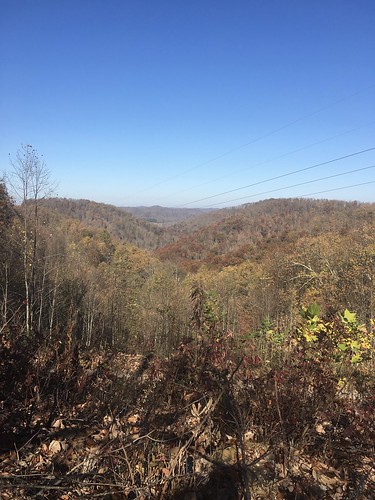
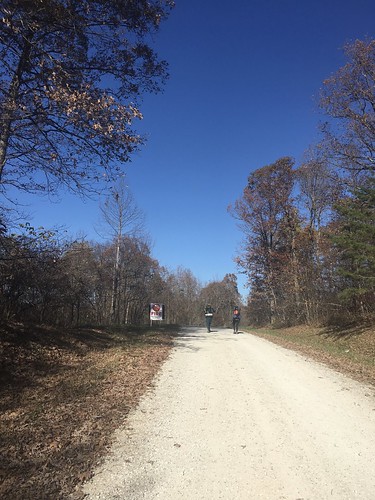
The hike outside of Morehead goes by Morehead State and climbs a steep set of switchbacks up some hills. We had worked up a sweat by the time we got to the top. There was still a bit of fall color lingering in the hills.

Last of fall colors

There was a lot of forest service road walking, and because it was the first weekend of rifle deer hunting season, there were lots of hunters out. Always remember to wear orange during fall and winter!

Walking Uphill

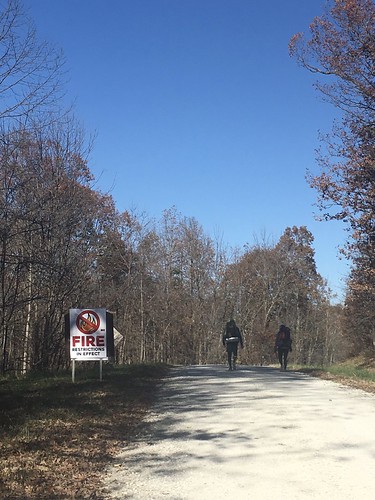
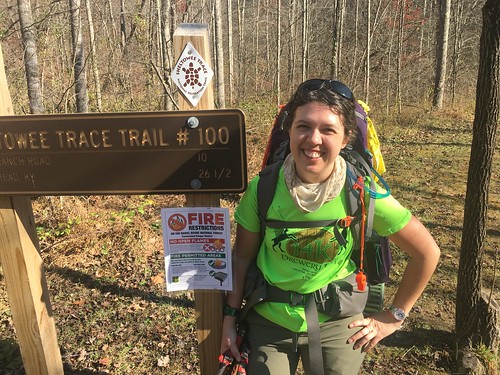
There was also a ban on fire in the area – at the time we were hiking, there had been recent forest fires further south in the Daniel Boone National Forest, around the Red River Gorge area.

Fire Warning

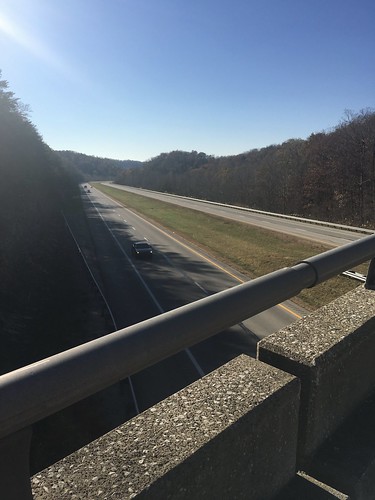
We had one last major crossing – over I-64.

Crossing I-64

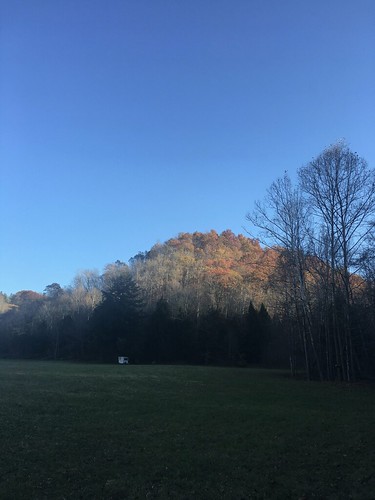
We arrived at camp a couple hours before twilight.

Hillside before twilight

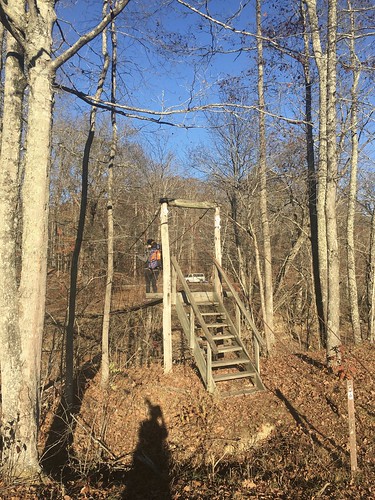
Field Suspension Bridge

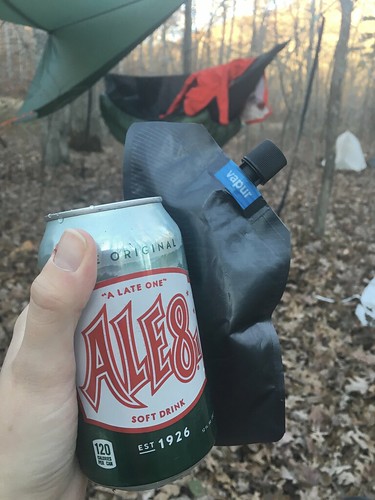
STA director Steve was kind enough to bring us sodas, so I kicked back with my FAVORITE post-hike cocktail: a can of Ale8 and some bourbon. Seriously, there is nothing better after a long day of hiking in Kentucky.

Post-hike cocktail of Ale8 and bourbon

We couldn’t have a campfire due to fire restrictions, but some Trail Angels (aka members of previous Sheltowee Trace End to End classes) brought us chili, warm cornbread, brownies, and hot beverages. Amazing! Most of us went to bed pretty early, since it was so darn cold without a fire.

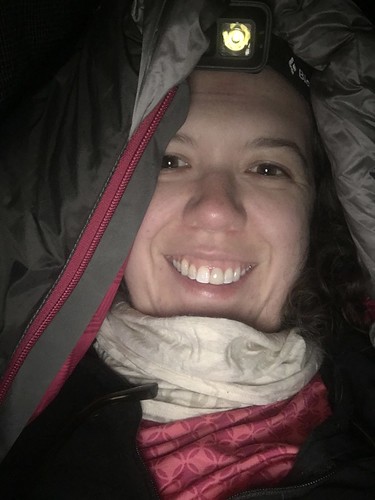
Here’s me hunkered down in my hammock – luckily I stayed pretty warm (and fortunately I packed a couple of those instant hand warmers, which helped keep my feet toasty), although my breath meant I had a lot of condensation on my sleeping bag in the morning.

Hunkering down for a cold night

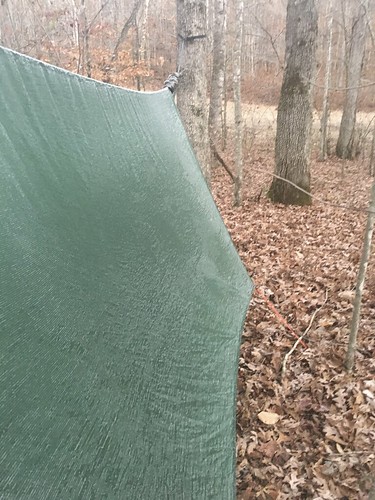
Here’s the frost that was on my tarp the next morning:

Frost on my tarp

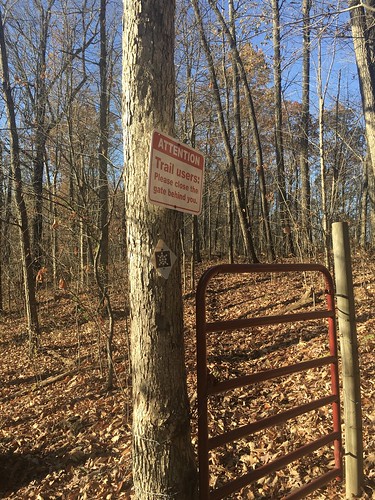
The hike out was fairly uneventful, though we did have to remember to close a couple gates behind us.

Close the gate

Honestly, I wish I could say I enjoyed the last few miles of this epic hike, but the recent election weighed very heavily on my mind that Sunday. I had some difficulty getting past the anxiety and fear to just zone out and bask in the final miles. Hiking is the best form of free therapy I’ve ever found, and even though maybe it’s never as instantly healing as I’d like, I know it’s always good to exercise my body even if my mind feels frantic.

Our trail angels made a reappearance at the end with sandwiches, snacks, and soda. Steve, STA director, was there to shake our hands and congratulate us as we crossed the finish line.

Crossing the finish line

Thank you to the trail angels and Steve for helping us celebrate a joyous occasion. I really look forward to joining everyone down in Livingston for a few weeks so we can all collectively celebrate our huge accomplishment. It’s no small thing to hike over 300 miles in one year. I am so grateful for the connections I made over the last year, and the beauty I got to see every month in this very special part of the country. I’ll be sharing more “closing thoughts” about the Sheltowee Trace. If you are interested in joining the Class of 2017, sign-ups are now open!

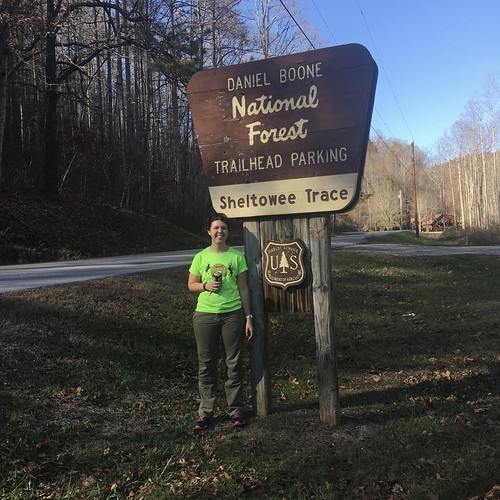
Trailhead Parking

Sheltowee Trace Northern Terminus

Susanna and I at the Northern Terminus

Saturday track:

Total distance: 14.81 mi
Download file: section-11-morehead-to-holly-fork-road.gpx

Sunday track:

Total distance: 12.23 mi
Download file: section-11-holly-fork-road-to-northern-terminus.gpx

PASIG 2016 talk: “The Voice of One Crying Out in the Wilderness: Preservation in the Anthropocene”
This is the lectern copy of the talk I gave at PASIG on October 28.  These were my slides (with apologies for how PDF conversion garbled the fonts). Thank you to the program committee for inviting me, and for the feedback and affirmation from the audience. I will be engaging with these ideas a lot over the coming months as I revise this talk for later publication.

Thank you to Hillel Arnold, Stephanie Bennett, Libby Coyner, Ben Goldman, and Erik Moore for their thoughtful remarks and editorial suggestions on the early drafts of this talk. I feel so fortunate and blessed to work in a profession with such generous colleagues.

Title: The Voice of One Crying Out in the Wilderness: Preservation in the Anthropocene

Eira Tansey


Introduction

In less than 100 years, the raw materials of growth have transitioned from an economy based on natural resources to a knowledge-based economy.[1] Historically, economic growth was driven by the natural resources of seemingly abundant and untamed wilderness. Today, the knowledge economy is fed by the digital resources of seemingly abundant and untamed electronic records.

As our language of economic value shifts from natural resources to digital resources, as we talk more often about mining data stored in clouds instead of mining coal from a mountain, I suggest that we stop and ask the following question: what can our history with the ideas of wilderness teach us about managing a flood of digital information?[2] This deep reflection is critical to our survival as we enter the anthropocene,[3] a period in which human traces can now be found in the Earth’s geologic record, a period in which wilderness is perceived as scarce, and a period where an unceasing volume of electronic records have assumed the wild abundance once associated with unmapped frontiers.[4]

Abundance and Scarcity

America’s founding mythologies revolve around making the land bend to the will of the powerful. This process was sustained by the creation of records and archives that asserted that the land was a wild place: whether wild with humans to be killed or removed through treaties that would inevitably be broken, or wild with trees and rivers to be surveyed and divided up through land claims.[5]

Indeed, archives are so strongly identified with the land in which records are created and maintained that when the writers of the Declaration of Independence listed among the “facts submitted to the world,” they found King George had:

“[…]called together legislative bodies at places unusual, uncomfortable, and distant from the depository of their public Records, for the sole purpose of fatiguing them into compliance with his measures.”[6]

The implication is clear, that records not only accorded legal rights, but that those records had a particular spatial significance as well. To be alienated from access to one’s records is to not just have one’s rights in question, but to be divorced from the land of legal rights. However, time and again throughout history, those who create and control records effectively control the land, and records articulate who is allowed to have a legal relationship with the land — and who can exploit the land for economic gain. I can think of no better current example than what is happening with the Dakota Access Pipeline.

America secured its nation-state status through conquering that which the colonists defined as wilderness. This process could not have been accomplished without the copious creation and use of records through maps, surveys, land grants, government reports, diaries, and letters that told us who or what was at the edge of civilization, and what value could be obtained by destroying indigenous people[7] and altering the landscape into profitable use.[8]

As the seemingly abundant wilderness became scarce, an influential group of white Americans began to rethink wilderness. Influenced by Romantic notions of beauty, and led by philosophers like John Muir, wilderness was re-imagined not as something to be exploited, conquered or feared, but as a precarious and precious resource deserving of protection.[9] However, there were vigorous disagreements about how this would be carried out. A group known as preservationists wanted to protect land for a panoply of aesthetic and moral reasons, with the implicit assumption that the main benefits would be realized by white nature enthusiasts. In contrast, conservationists argued that protection could be realized through the highly-regulated management of natural resources for economic growth, however this approach to management rarely, if ever, drew on indigenous land management knowledge and practices.[10] Once again, records were created to advance the arguments of both sides.

In the midst of the Great Depression, American wilderness and American archives rounded a similar bend. In August 1933, a major executive branch reorganization resulted in a major expansion of the National Parks Service, and less than a year later, FDR signed legislation creating the National Archives. In both cases, New Deal-era management brought together fragmented and endangered pieces of natural and cultural heritage under centralized control.[11]

As we transformed land into raw material for economic growth, and as we produced increasing numbers of records for the expansion of markets and the state, we have arrived at the point where we designate wilderness as a scarcity requiring legal management, and struggle to control an abundance of fragile information.[12] A common thread unites those charged with environmental preservation and those charged with digital preservation: the idea that their work is the “last line of defense” between continued existence – of land or of records – and of destruction.[13] A mountain that is strip mined can be filled in with grassland but the stratigraphy is effectively gone. A digital dark age looms over websites not yet crawled and files not yet checksummed, as archivists race to fill the holes and gaps of our digital cultural heritage.[14]

Three Questions

So what can we learn from our relationship with wilderness as we attempt to control a deluge of digital information? I propose the following questions:

  1. Who do we preserve for?
  2. What should we preserve?
  3. Are we preserving for today or for tomorrow?

Over time, land and records preservation benefitted very narrow populations. The earliest national parks were set aside not for ecology or to benefit the majority of Americans, but for the recreational enjoyment of primarily white, usually wealthy, nature enthusiasts, sportsmen, and tourists.[15] Likewise, the earliest American archives were established not to preserve documentation for all people, but of privileged government interests and the transmission of elite memory.[16] Over the last several decades, an increasing awareness of ecology and the erasure of indigenous populations and people of color has led to new approaches to federal and state land protection.[17] Likewise, the expansion of the “archival multiverse” recognizes the need to represent those who had been historically excluded from archival memory, whether by new appraisal or collection strategies, or by the establishment of community archives outside of oppressive institutions.[18]

What we preserve reflects societal values of collectively-shared resources. Protected land frequently takes different forms; National Parks with varying levels of tourist development, national and state forests with large areas dedicated to logging and mineral extraction, and historic neighborhoods with residents and protected buildings. Land often passes through different types of protection designations over time depending on a variety of legal, cultural, and environmental factors. Likewise, archivists have based decisions on what should be preserved – a function we refer to as appraisal – on a variety of values and frameworks. Records are sometimes appraised based on their inherent value, or their usefulness to others, including scholars, institutional users, or society at large.[19]

Finally, is our drive to preserve motivated by today’s needs or tomorrow’s? By designating something for preservation – land, records –  we imply that it has some form of inherent value that outweighs the costs. And it is here that preservation of land and preservation of digital information face their greatest challenges: the tendency of American culture to value immediate profit or realize short-term gains with the assumption that “tomorrow” is something we will never have to deal with. Otherwise, how do we explain why we even entertain the idea of oil pipelines despite every scientific recommendation urging us move to non-fossil fuel power as soon as possible? Why do we continue to buy more storage to attempt to save everything digital, ensuring the digital replication of the massive paper archives backlogs archivists a generation ago worked so hard to eliminate? In both cases, we have constructed the risks to be something that won’t actually catch up to us in immediate ways, and therefore we ignore  the real impact.

However, the anthropocene demonstrates that  the chronological window between “today’s needs” and “tomorrow’s needs” is rapidly collapsing.[20] Scientific observations demonstrating how much faster the Earth is hitting climate records than originally anticipated shows us that what we thought of as “tomorrow” is arriving on the edges of “today.”[21] Choosing to preserve for tomorrow’s needs is preserving for today’s. As yesterday’s mines become today’s servers, and as data becomes the coal of the 21st century, abundance and scarcity alone cannot guide our preservation decisions. Friends: we must also consider for whom and why we preserve in the first place.

References:

[1] Powell, W. W., & Snellman, K. (2004). The knowledge economy. Annual review of sociology, 199-220.

[2] Throughout this paper I deliberately choose qualifying words around wilderness such as “seeming”, “perceived”, and “ideas” to reflect the position of many environmental historians that almost no landscape has been free from human manipulation.

[3] It has become very hip in environmental and futurist discourse to cite the anthropocene, and I am aware of my reinforcement of this in doing the same. However, there is an emerging scientific consensus on an actual geological epoch called the anthropocene, with actual geologists coming to a commonly-agreed upon point at which human influence can began to be seen in the geological record. For more information, see https://www.theguardian.com/environment/2016/aug/29/declare-anthropocene-epoch-experts-urge-geological-congress-human-impact-earth and http://dotearth.blogs.nytimes.com/2012/09/17/the-anthropocene-as-environmental-meme-andor-geological-epoch/?_r=0 . The official scientific working group dedicated to this work can be found at http://quaternary.stratigraphy.org/workinggroups/anthropocene/

[4] A small but persuasive group of archivists have previously made strong arguments for conceptualizing archival theory through philosophical frameworks of ecological health and sustainability. I owe a great deal of intellectual debt to those who’ve navigated this land before me: Abbey, Heidi N. “The green archivist: A primer for adopting affordable, environmentally sustainable, and socially responsible archival management practices.” Archival Issues (2012): 91-115, Loewen, Candace. “From human neglect to planetary survival: new approaches to the appraisal of environmental records.” Archivaria 1, no. 33 (1991), Moore, Erik A. “Birds of a Feather: Some Fundamentals on the Archives-Ecology Paradigm.” Archivaria 63, no. 63 (2007), Taylor, Hugh A. “Recycling the Past: the Archivist in the Age of Ecology.” Archivaria 1, no. 35 (1992), and Wolfe, Mark. “Beyond “green buildings:” exploring the effects of Jevons’ Paradox on the sustainability of archival practices.” Archival Science 12, no. 1 (2012): 35-50.

[5] Two of the seminal works on American wilderness theory are Roderick Nash’s Wilderness and the American Mind and Bill Cronin’s responding criticism, The Trouble with Wilderness. Suffice to say that wilderness, at least in its American construction, is regarded by many environmental historians as an artificial construct. Early histories of wilderness are imbued with a historical outlook that at best, downplays or misrepresents the relationship that indigenous people had with the land at the time of European contact, and at worst, actively erases them from the narrative.

[6] Declaration of Independence, 1776 July 4, National Archives and Records Administration. http://www.archives.gov/exhibits/charters/declaration_transcript.html

[7] These destructive actions also affected indigenous knowledge systems. An excellent account of recent efforts to establish tribal archives and decolonize American archival practice can be found in O’Neal, Jennifer R. “” The Right to Know”: Decolonizing Native American Archives.” Journal of Western Archives 6 (2015).

[8] There is an interesting strain in environmental history that cautions against declensionist thinking (see: http://niche-canada.org/2016/02/03/counterbalancing-declensionist-narratives-in-environmental-history/) but my archival training and outlook requires me to consider why records are created and for what function, and it would seem that early records created by colonists were primarily to function as introducing a legal function of control over the land.

[9] Roderick Nash’s Wilderness and the American Mind, Chapters 8-10. Bill Cronin, The Trouble with Wilderness. : Environmental History, Vol. 1, No. 1 (Jan., 1996), pp. 7-28. Finney, Carolyn. “Black faces, white spaces.” (2014), pp. 28-29.

[10] The main figures often identified with each movement’s early period are John Muir (preservation) and Gifford Pinchot (conservation). Muir’s early writings disparaged blacks and Native Americans he encountered during his travels, and Pinchot was an advocate of eugenics.

[11] https://www.archives.gov/about/history/building.html and http://npshistory.com/publications/timeline/index.htm When the National Archives opened in 1934, it started with a massive abundance of records – 1 million meters, with a growth rate that increased during WWII. See Cook, Terry. “What is past is prologue: a history of archival ideas since 1898, and the future paradigm shift.” Archivaria 43 (1997). The most famous residing documents of the National Archives were not all present after its opening – the Constitution and Declaration of Independence did not come into the National Archives possession until 1952, following negotiations with the Library of Congress.

[12] Wolfe’s “”Beyond Green Buildings” is an excellent examination of how Jevon’s Paradox intersects with the archival “age of abundance”

[13] Ericson, Timothy L. “At the” rim of creative dissatisfaction”: Archivists and Acquisition Development.” Archivaria 33 (1991).

[14] While it is beyond the scope of this talk, both environmental historians and archivists have an evolving relationship with the concept of authenticity. Many environmental historians have shown that humans have a long history of manipulating and altering landscapes, and archivists since Jenkinson have questioned the idea of archives as infallible sources of truth.

[15] Many National Parks were created by actively removing indigenous residents, or forbidding tribal access to lands for sustenance and sacred purposes. See Merchant, Carolyn. “Shades of darkness: Race and environmental history.” Environmental History 8, no. 3 (2003): 380-394, and Spence, Mark David. 1999. Dispossessing the wilderness: Indian removal and the making of the national parks. New York: Oxford University Press.

[16] A particularly interesting case study of early American institutional archives concerns the first formally-organized state archives. These were established in the South, and very explicitly reinforced a Lost Cause white supremacist version of history. See Jimerson, Randall C. 2009. Archives power: memory, accountability, and social justice. Chicago: Society of American Archivists (pp. 94-97) and Galloway, Patricia. “Archives, Power, and History: Dunbar Rowland and the Beginning of the State Archives of Mississippi (1902-1936).” The American Archivist 69, no. 1 (2006): 79-116.

[17] Everglades National Park was arguably the first NPS unit established with ecological concerns as the primary factor (as opposed to scenic landscapes), https://home.nps.gov/ever/learn/management/upload/2008%20DRTO%20EVER%20Final%20Supt%20Annual%20Report.pdf . For more on the relationship between the NPS and tribal nations, see King, Mary Ann. “Co-management or Contracting-Agreements Between Native American Tribes and the US National Park Service Pursuant to the 1994 Tribal Self-Governance Act.” Harv. Envtl. L. Rev. 31 (2007): 475, and for federal/state land management and tribal nations: Wood, Mary C., and Zach Welcker. “Tribes as trustees again (Part I): the emerging tribal role in the conservation trust movement.” Harvard Environmental Law Review 32 (2008).

[18] McKemmish, Sue, and Michael Piggott. “Toward the archival multiverse: Challenging the binary opposition of the personal and corporate archive in modern archival theory and practice.” Archivaria 76 (2013).

[19]  Within the realm of archival theory and environmental history, American perspectives on appraisal and wilderness have respectively occupied notably controversial niches that have produced enormous quantities of arguments within the two bodies of literature. For this reason as well, considering them in parallel makes for an intriguing comparative analysis.

[20] My colleague Hillel Arnold also noted that there is a similar parallel of a collapsing window in the archives profession, with the increasingly short period of time in which to preserve the highly ephemeral records generated by historical events (e.g., social media archives of activist movements like the Arab Spring or Black Lives Matter).

[21] http://www.scientificamerican.com/article/how-the-ipcc-underestimated-climate-change/